Watanzania tuige mfano wa Ujerumani, tunapaswa kumsahau Magufuli na kuweka bidii kusonga mbele

Watanzania tuige mfano wa Ujerumani, tunapaswa kumsahau Magufuli na kuweka bidii kusonga mbele

Maendeleo ya kuwafanya wananchi kwa angalau wawe na usawa yaani kupunguza tabaka la wenye nacho na wasio nacho, kati yake lazima kuna mmoja aumie

Kile ambacho alikuwa akikifanya Magufi ni kujaribu kupunguza tabaka hilo, kitu ambacho kiliwaumiza wenye nacho na wale ambao walikuwa wapo kwenye milija ya ulaji

Na ndiyo maana JPM ataendelea kukumbukwa na mamilioni ya Watanzania walala hoi ambao ndio alikuwa akiwatetea na shabaha yake ni kuwasogeza kwenye hali ya unafuu wa maisha, na ndiyo maana alijaribu hata kuruhusu kila mtu ajitafutie riziki lake popote pale mpaka hapo serikali inapowatengenezea mazingira rasimi ya kufanyia biashara zao

Vongozi wa aina hii huwa wachache mno, wengi wao wa viongozi, hujikuta wakiendelea kuwatengenezea mazingira mazuri kwa walionacho tu na kuwaongezea zaidi na zaidi na kuwasahau kabisa hao wanaojaribu bahati zao katika kujitafuta

Na kamwe, Magufuli ataendelea kuchukiwa na hao hao ambao JPM alijaribu kuziba mirija ya ukwapuaji

Na kwa sababu hiyo, Wale ambao wako upande wa Magufuli kumtetea kwa nguvu zote bila kujali na wasiamini wasemayo hao wanaosema waliumizwa, ni hao mamilioni ya Watanzania walala hoi na mimi nikiwemo na wala siwezi kujificha kwa sababu tu ya hao ambao wameifanya nchi hii kama mali ya babu zao!


Synthesizer Umeongelea jambo mhimu sana mkuu, binafsi nakuunga mkono, ila viongozi wajitahidi mno kuwatendea haki wananchi wote ilikwa pamoja tugawane sote hiyo keki ya Nchi yetu
Asante Mkuu. Ndio maana nasema ili kwenda mbele, ni lazima kudraw neutral line. Historia itaandika mazuri na mabaya ya Magufuli, lakini katika kushughulika na yanayotukabili sasa, hatuhitaji kumtaja, kumlinganisha nk. Tunahitaji kwenda mbele pamoja, la sivyo tofauti kati yetu hazitaisha. Siku zote tutakuwa na watu wa Magufuli na watu wa Samia, kutegemea jinsi watu walivyoguswa na mambo ya Mafuli na wanavyoguswa na mambo ya Samia.

In fact, japo sipendi kuchagua pande, kama ningeombwa ushauri, ningesema labda hata katika uchaguzi wa 2025 tuwe na candidate ambae hana legacy ya Magufuli, ili ku-drive home sense ya kwamba tunaanza upya.
 
Wajerumani historia ya Adolf Hitler na u-NAZI wanaendelea kujifunza ili wasirudie makosa ya mihemuko ya miaka ya 1918 hadi 1938 kuwaamini watu aina ya Adolf Hitler na chama cha NAZI wasiweze kujipenyeza katika siasa za Ujerumani.

Na hii hufanikiwa kwa kutosahau wala kuona haya hivyo kutofundisha historia bali wajerumani wanaendelea kujifunza ilikuwa vipi wakatumbukia mikononi mwa watu aina ya Adolf Hitler na kujikuta nchi ikipitia magumu raia kutekwa na kupotezwa na GESTAPO askari wa usalama, raia kujazwa itikadi potofu, raia kujazwa ubaguzi, raia kupotoshwa kuunga mkono vita vya kijinga wakauawa kwa mamilioni n.k n.k

Hivyo ni muhimu Tanzania kutosahau utawala wa 2015 -2021 kujua mapungufu ya kiuongozi, iliwezekana vipi CCM kutumbukizwa kumteua Magufuli, miradi mikubwa ya kimkakati kutumia kama chambo cha kubadili katiba ili mtawala aimalizie hata kama itachukua miaka 30 kwa makusudi ili kupaki madarakani kwa kuwa yeye ni kiongozi mithili ya masiha aliyeteremshwa kuokoa taifa, watu kupotezwa, watu wasiojulikana wa dola n.k n.k

Kufanya cheo cha urais ni nafasi ya kutumia kodi za wananchi kupeleka miradi kijijini mfano Chato International Airport ambayo sasa ni kiwanja mfu (White elephant) n.k
 
Wasiojifunza kupitia Historia wana hatari ya kuirudia tena
Ndio maana historia haipaswi kupuuzwa, na Wajerumani hawajaipuuza ili wasirudie yaliyofanywa na Hitler. Lakini katika kuendeleza nchi yao, Hitler hatajwi.
 
Magufuli pia alitaka kuiweka Tanzania katika top tena za dunia. Kuifanya donor country. Kumbuka malengo yake? Dar es Salaam iwe kama Ulaya.
Dunia ya kichwani mwake labda.

Waliotaka kuziweka nchi zao top ten za dunia tumewaona kwenye stages za kimataifa.

Wakati Magufuli anajifungia kwake Tanzania kama mwali wa Kizaramo anayesubiri kuchezwa.
 
Wakitaka Magufuli asahaulike;

1. Wahakikishe wanachukua RUSHWA!!

2. Wahakikishe wanawahurumia wananchi wa kipato Cha chini.

3. Wahakikishe maoni ya wananchi yanasikilizwa.

4. Wahakikishe pesa za umma hazicheziwi Wala kuibwa, na miradi ikamilike Kwa wakati.

Hapo atasahaulika, tofauti na hapo, KITI hicho hakitakalika.
Nimeuliza hivi, ili kufanya hayo mambo mazuri uliyosema hapo juu, ni lazima tuyafanye katika jina la Magufuli?
 
Muhimu kusoma na kupenda somo la historia ili mfano mambo ya utawala wa 2015 - 2021 Yasitokee:

14 April 2023
🔴LIVE: UZINDUZI KITABU CHA MAGUFULI "I AM THE STATE" || KIBANDA, MBOWE WASHUSHA NONDO


View: https://m.youtube.com/watch?v=DQHdpRARpV8


Search

Book ‘I AM THE STATE: A President’s Whisper From Chato’ Launched​

1712746292761.png

Written by Tanzanian journalists, the book details the contested legacy of former leader John Magufuli.

The Chanzo Reporter


Dar es Salaam. A book launched here on Friday examines the legacy of former leader John Magufuli, looking specifically at the late president’s attempts to develop his hometown of Chato, a town in northwestern Tanzania, a decision that authors claim raised many questions.
Titled I AM THE STATE, A President’s Whisper From Chato, the book is a joint effort by veteran Tanzanian journalists – Ansbert Ngurumo, Jesse Kwayu, Neville Meena, and Absalom Kibanda – to document Magufuli’s legacy for posterity.
Magufuli, the fifth-phase president of Tanzania, died on March 17, 2021, leaving behind a contested legacy. While some extol him as an anti-corruption tsar, others have criticised him for overseeing a dictatorial regime that violated fundamental human rights.

Edited by veteran journalist and trainer Ndimara Tegambwage, the book contains six chapters by different authors which examine Magufuli’s legacy from various perspectives by detailing what happened during his five-year administration, 2015-2021.
Bishop Benson Bagonza of the Evangelical Lutheran Church in Tanzania (ELCT), Karagwe Diocese, was the guest of honour during a function to launch the 75-page book at the Peacock Hotel in Dar es Salaam.


Senior journalists and editors, CHADEMA national chairperson Freeman Mbowe, and Secretary of the Council of Islamic Organisations in Tanzania, Sheikh Issa Ponda, were among many other dignitaries that blessed the event.

Speaking shortly before launching the book, Bagonza applauded the journalists for their initiative, noting that the book serves as a reminder of the importance of Tanzania in evaluating itself as a nation.
Bagonza, a constant commentator on the country’s affairs, noted that any country needs people, no matter their number, who are brave enough to present the public with alternative information amidst emotional celebratory and congratulatory mood.

“This book demands us to stop congratulating each other and discuss complex issues for the future of our country,” Bagonza said in his speech.

“We must remember that Tanzanians never elected angels to be their leaders,” the cleric said. “They elected fallible people. Evaluating ourselves is an important element in the process of governing ourselves.”

He said the book details how it was normal under the previous administration to spend taxpayers’ money outside of the budget approved by the parliament, a decision he described as a “blow” to the lawmaking body.

“[The book] is part of the movement to demand the establishment of strong check and balance institutions capable of holding our leaders to account when they knowingly violate the country’s laws,” Bagonza explained.

On his part, Mr Mbowe congratulated the journalists for writing the book, something he thinks breaks the tradition of typical Tanzanian journalists.
According to Mr Mbowe, journalists in the country are not implementing their role to inform the public effectively, noting that that has to change if Tanzania is to register any positive developments.

He pointed to the recent revelations by the Controller and Auditor General (CAG) on the massive corruption and misuse of public funds within the government as an example, thinking that the media are yet to inform the public of the gravity of the situation.

“If journalists are bitter about this level of corruption, they’re better placed to shape this nation’s future,” Mr Mbowe told journalists.

Speaking about the book, one of the authors, Kibanda, said the book seeks to attack no one, explaining that they were moved to write it to fulfil their social responsibility as journalists.

Kibanda said that as journalists, they observed how Mr Magufuli was determined to develop his hometown of Chato, which not only exposed the late president as brave, creative, and daring but also self-centred and tribalistic.

“We saw with our own eyes how developments were directed to Chato: banks, an international airport, and even wild animals,” Kibanda said. “Some critics even started changing Chato’s name to Gbadolite.”

Gbadolite was the ancestral home and residence of Mobutu Sese Seko of Zaire, now the Democratic Republic of Congo (DRC), where he built an airport, colleges, malls, supermarkets and libraries in a program of modernisation.

“Our book looks at the status of many of these projects invested in Chato during the previous administration,” Kibanda said. “We reveal how and why these projects came into existence and what remains of them now.”
“We are not doing this to reopen old wounds,” Kibanda cautioned. “No, we are doing this as part of the process to build a strong foundation for the future of our country.”

The book is available at bookstores across the country and sells at Sh15,000. It is available in English, but its authors said its Kiswahili translation is in the offing.

The Chanzo Reporter​

 
Wajerumani historia ya Adolf Hitler na u-NAZI wanaendelea kujifunza ili wasirudie makosa ya mihemuko ya miaka ya 1918 hadi 1938 kuwaamini watu aina ya Adolf Hitler na chama cha NAZI wasiweze kujipenyeza katika siasa za Ujerumani.

Na hii hufanikiwa kwa kutosahau wala kuona haya hivyo kutofundisha historia bali wajerumani wanaendelea kujifunza ilikuwa vipi wakatumbukia mikononi mwa watu aina ya Adolf Hitler na kujikuta nchi ikipitia magumu raia kutekwa na kupotezwa na GESTAPO askari wa usalama, raia kujazwa itikadi potofu, raia kujazwa ubaguzi, raia kupotoshwa kuunga mkono vita vya kijinga wakauawa kwa mamilioni n.k n.k

Hivyo ni muhimu Tanzania kutosahau utawala wa 2015 -2021 kujua mapungufu ya kiuongozi, iliwezekana vipi CCM kutumbukizwa kumteua Magufuli, miradi mikubwa ya kimkakati kutumia kama chambo cha kubadili katiba ili mtawala aimalizie hata kama itachukua miaka 30 kwa makusudi ili kupaki madarakani kwa kuwa yeye ni kiongozi mithili ya masiha aliyeteremshwa kuokoa taifa, watu kupotezwa, watu wasiojulikana wa dola n.k n.k
Hapa umemalizia kuandika upuuzi tupu
 
Nimeuliza hivi, ili kufanya hayo mambo mazuri uliyosema hapo juu, ni lazima tuyafanye katika jina la Magufuli?
Sasa utaachaje kuyataja mazuri ya Magu kama mfano?

Mbona Nyerere, Mkapa, Kikwete wanatakiwa, why isiwe Kwa Magu?
 
Unafananisha sura au philosophy? Mie niko kwenye mentality, na usije ukaniambia mbona Magufuli hakuanzisha gari kama Hitler. Nitakuambia nenda shule kasome.
Dhana nzima ya uzalendo ni chaka kubwa linalotumiwa na madikteta na mafashisti kukamilisha mambo yao tu.

Na ukiiweka hapa dhana hiyo, utakuwa na kazi kubwa ya kutenganisha uzalendo na Machiavellian politics zinazotumia gia ya uzalendo kukamilisha tamaa za viongozi kutawala tu.
 
Dunia ya kichwani mwake labda.

Waliotaka kuziweka nchi zao top ten za dunia tumewaona kwenye stages za kimataifa.

Wakati Magufuli anajifungia kwake Tanzania kama mwali wa Kizaramo anayesubiri kuchezwa.
Hapana, alikuwa na mifano halisi, Singapore, South Korea na Malysia nadhani. Kwa hiyo alikuwa na nia nzuri, ila philosophy yake ya "the end justifies the means" ndio ilikuwa na tatizo. Na lazima tukiri Singapore waliendelea kwa kasi kwa kutumia philosophy hiyo. Waliumizwa sana kufikia maendeleo waliyo nayo sasa. Hilo linajulikana na Magufuli alilipenda.

Hata Kagame kaamua kutumia philosophy hiyo ya Singapore, na wapo watu wanasema anafanikiwa kuifanya Rwanda the Swiss of Africa, kwa sababu wanaangalia "visible Rwanda" bila kuangalia "invisible Rwanda"
 
Kuna kumsahu Magufuli, na kusahu historia. Hakuna mahali nimesema tusahau historia ya Tanzania. Usichanganye haya mambo mawili.
Hakuna sehemu nimesema tusahahu Historia. Usijichanganye. Usinilishe maneno

Magufuli hawezi kusahaulika kwa vyovyote vile, ila tunaweza kukataa Nchi kuuzwa kwa Waarabu mchana kweupe.

Hatahivyo, kusema kuwa Magufuli aliuwa watu kama Hitler nayo siyo sahihi. Unapotosha. Kusema tumsahahu magufuli ni kutuambia tusahau Historia.

Magulification Will Go on.


Wawekezaji ni wanyonyaji.
 
Umefananisha Simba na Nyani.

Mifano yako Haina uhusiano sawa.

JPM awe kama Hitler kweli? Au unahadithi za vijiweni?
Hitler kapigana vita ambavyo vina faida kubwa kwa nchi kwa dunia, lakini huyu wakuwinda wakosoaji vinaleta faida gani?
 
Hapana, alikuwa na mifano halisi, Singapore, South Korea na Malysia nadhani. Kwa hiyo alikuwa na nia nzuri, ila philosophy yake ya "the end justifies the means" ndio ilikuwa na tatizo. Na lazima tukiri Singapore waliendelea kwa kasi kwa kutumia philosophy hiyo. Waliumizwa sana kufikia maendeleo waliyo nayo sasa. Hilo linajulikana na Magufuli alilipenda.

Hata Kagame kaamua kutumia philosophy hiyo ya Singapore, na wapo watu wanasema anafanikiwa kuifanya Rwanda the Swiss of Africa, kwa sababu wanaangalia "visible Rwanda" bila kuangalia "invisible Rwanda"
Magufuli angeanzisha mambo ya kupambana kiuchumi kinataifa ningeweza kujueleea.

Magufuli kashindwa biashara ya korosho tu, unamlinganishaje na Singapore?
 
Dhana nzima ya uzalendo ni chaka kubwa linalotumiwa na madikteta na mafashisti kukamilisha mambo yao tu.

Na ukiiweka hapa dhana hiyo, utakuwa na kazi kubwa ya kutenganisha uzalendo na Machiavellian politics zinazotumia gia ya uzalendo kukamilisha tamaa za viongozi kutawala tu.
Nakubaliana na wewe 100% kabisa. Na swali sasa ni kama Magufuli alikuwa mzalendo in the real meaning of uzalendo, au alikuwa a misconceived mzalendo ambae ali-justify yale yasiyofaa kwa kutumia excuse ya uzalendo
 
Hitler kapigana vita ambavyo vina faida kubwa kwa nchi kwa dunia, lakini huyu wakuwinda wakosoaji vinaleta faida gani?
Mkuu, Hitler aliwawinda sana wakosoaji, na kuwaua! Sasa hatutaacha kumlinganisha Magufuli na Hitler kwa sababu Magufuli hakuanzisha vita ya dunia. Ndio maana nimesema kwamba ulinganifu wa Magufuli na Hitler ni katika philosophy zao, mentality, sio katika matukio kama kuanzisha vita ya dunia.
 
Nakubaliana na wewe 100% kabisa. Na swali sasa ni kama Magufuli alikuwa mzalendo in the real meaning of uzalendo, au alikuwa a misconceived mzalendo ambae ali-justify yale yasiyofaa kwa kutumia excuse ya uzalendo
Magufuli katumia tu gia ya uzalendo kukamilisha haja zake za kisiasa.

Hata uzalendo hakuelewa maana yake.
 
Sidhani kama kuna Mtanzania ambae hajui mazuri ya Magufuli akiwa raisi wa Tanzania, atapinga kwamba Magufuli hakuwa na roho ya uzalendo kwa Tanzania, alichukia ufisadi, alichukia watu ambao anawaona walikwamisha bidii zake za kuindeleza Tanzania. Hakuna Mtazania atakaepinga kwamba Magufuli alikuwa mchapa kazi kweli kweli, mwenye kupenda nchi yake na raia wa Tanzania, mzalendo namba moja.

Lakini hilo linakukumbusha nini?

Linatukumbusha kiongozi aliewahi kuwa na hulka ya Magufuli pale Germany, Adolf Hitler. Hitler alikuwa mzalendo kweli kweli. Alisimamia Germany na kuifanya Germany kuwa taifa lenye uchumi wenye nguvu kuliko mataifa yote. Alipenda uzalendo, alichukia ufisadi na usaliti dhidi ya nchi yake. Hitler alikuwa muasisi wa gari za VW, Volks Wagen (People's Car) ili kila raia wa Germany aweze kumudu kuwa na gari. Hakuna kiongozi katika Germany anaeweza kusemwa alileta maendeleo kwa nchi yake kama alivyofanya Hitler, mzalendo namba moja wa nchi yake.

Lakini sasa, nani leo unamsikia akimsifia Hitler kwa makubwa aliyoifanyia Germany? Hakuna, kwa sababu hakuna mtu aliyesahau machungu yaliyosababishwa na Hitler.

Hakuna mtu hapa Tanzania asiyejua machungu yaliyoletwa na Magufuli katika azma yake ya kuiendeleza Tanzania, machungu ambayo hayana utetezi hata uyaangalie kwa mtazamo upi. Hayana justification.

Hata hivyo, kwa tulio hai, kuwachukia Hitler au Magufuli, ambao tayari wamekufa, ni dalili kwamba tuna matatizo ya afya ya akili, tunahitaji psychiatric help. Kuwasifia pia ni tatizo, kwa sababu tunaumiza wale walioumizwa nao, ambao bado wapo hai pamoja nasi. Tutapanda gari za VW za Hitler, tutapita kwenye flyover za Magufuli, lakini hatutaimba sifa zao.

Kama Germany ilivyoamua kumsahau Hitler pamoja na mazuri aliyoifanyia nchi yake, Tanzania tunapaswa kumsahau Magufuli pamoja na mazuri aliyoifanyia nchi yetu.

Tuangalie mbele sasa. Tusahau yaliyopita, tuachane na kulinganisha uongozi wa sasa na uliopita. Tuvunje magenge. Tuanze upya.

The world and your country need YOU now, not Hitler, not Magufuli.
Tusaidie kuliondoa jimama 2025 maana kanogewa anataka mitano Tena .
 
Kwani waganda wamemsahau Iddy Amin?
Katika mambo ya kila siku wamemsahau kabisa, na si rahisi uwe Uganda usikie mtu anasema ooh Mseveni sio kama Idd Amin nk. Ila hawajasahu historia ya Uganda na Idd Amin. Ndio maana katika maamuzi fulani anayofanya Museveni sasa, wanasema usije ukaturudisha katika hali ya wakati wa Idd Amin
 
Tusaidie kuliondoa jimama 2025 maana kanogewa anataka mitano Tena .
Na kwa wale mnaotaka kumuondoa mama 2025, kazi yenu inakuwa kubwa zaidi mnapotumia jina Magufuli kumwonda, kwa sababu hapo hamjengi hoja kwa nini mnataka aondoke 2025, bali mnatumia kivuli cha Magufuli. Unaposema tumuondoe mama 2025 kwa sababu hayuko kama Magufuli, tayari unawatenga wale walioumizwa na Magufuli hata kama una valid points za kutaka mama aondoke 2025. Wao watampigia mama kura si kwa sababu wanampenda mama au wanaona ni mchapakazi, bali kwa kuwa hawakupendi wewe unaempenda Magufuli hadi leo.
 
Yasitokee
Hapa umemalizia kuandika upuuzi tupu

Ujerumani mbali na katika somo la historia kufundisha utawala wa NAZI ya Adolf Hitler walifanya nini, magazeti na media kujadili kwa kina utawala wa Adolf Hitler pia wamefungua makumbusho maalum ili kusaidia kuondoa mabaki ya kifikra ya wafia-utawala wa Adolf Hitler wanaotaka kumfanya ni malaika, mwokozi, mzalendo

TOPICS

DENAZIFICATION​

It was clear to the victorious Allies of World War II well before the German army capitulated in 1945 that the entirety of German society would need to be cleansed of Nazi influences and effects, and that the Germans would need to be “re-educated” in democratic values. It was relatively simple to repeal Nazi laws, remove symbols of the National Socialist regime from the public realm, cull unwanted books from the libraries, obliterate the swastikas on forms and paperwork, and change street names. A much greater problem was what to do with the some 8.5 million members of the Nazi Party (NSDAP), and the many more millions out of a German population of 70 million who had belonged to one or another Nazi organization – how to denazify them.
While legal proceedings such as the 1945/46 Nuremberg Trial of the major war criminals were judicial prosecutions of specific crimes, denazification took a different shape. Its goal was to politically cleanse German society and make sure that people who had been involved with the Nazi regime were excluded from important positions in society and the future state institutions.
6.0-01-entnazifizierung-1024x682.jpg
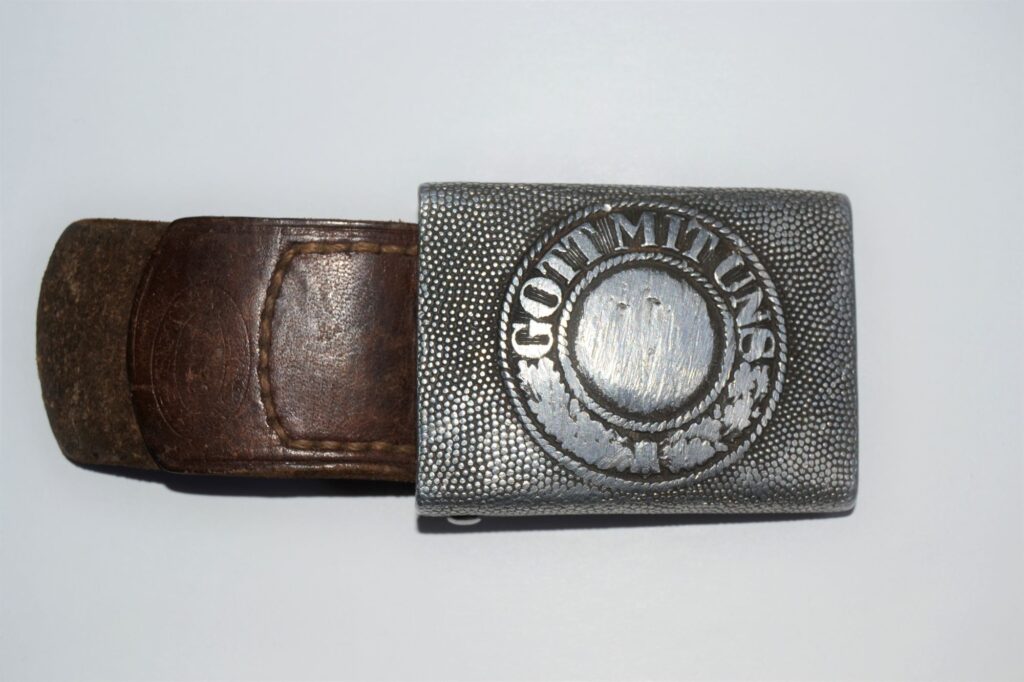
Belt with Wehrmacht buckle from the postwar period. The swastika on the visible front side has been removed, but the one on the inside of the buckle is still there. (AlliiertenMuseum/W. Chodan)

INTERNMENT AND DENAZIFICATION PROCEDURES​

Immediately following the end of the war, active Nazis and functionaries – in particular, police, members of the SS, and civil servants – were removed from their posts by the Allies and subject to “automatic arrest.” Between 1945 and 1950, the Allies preemptively detained more than 400,000 Germans in internment camps without case-by-case reviews. In the Soviet occupation zone, it was not only former Nazis, but also many people the Soviets considered political opponents, who were detained in what were called special camps.
A man stands in front of a table and hands a denazification questionnaire to the woman sitting behind it.
Submitting the denazification questionnaire in Berlin’s Steglitz district, 1946 (National Archives in Washington, D.C.)
There was disagreement among the four occupying powers about the specifics of how the political cleansing should be carried out; initially, there was neither a joint course of action nor a joint objective, and the denazification procedures differed accordingly. It was not until January 1946, after long discussion, that the Allied Control Council issued Directive no. 24 containing guidelines for a coordinated approach across Germany.
FURTHER READING
The occupying powers turned responsibility for denazification over to the Germans as early as 1945/46. In each occupation zone, various forms of commissions, committees, and denazification tribunals called spruchkammer, made up of former resistance fighters, unionists, professional and lay judges, and similar people, vetted individuals. In quadripartite Berlin, there was a joint procedure for the four powers – at least on paper. In all of the occupation zones and/or sectors, the classification and ruling by the spruchkammer, commissions, and committees was made on the basis of a comprehensive questionnaire. The respondents had to provide detailed and truthful information about their political biography, including membership in the Nazi Party or any other Nazi organization. The sanctions that might be imposed included fines, forced retirement, or even confinement to a labor camp. Many people produced exculpatory sworn statements. Since incriminating documents were often difficult to unearth, those written attestations – from friends or neighbors, say – contributed significantly to the fact that the overwhelming majority of cases were classified in the 4th category “Followers.” Only 1.4 percent of the people undergoing denazification ended up classified as “Major Offenders” or “Offenders.” An official ruling that a person had been classified as “Exonerated” or a “Follower” – and by association, the exculpatory sworn statements – were later to be known colloquially as “persil” certificates, a reference to a popular laundry detergent, meaning the document had “whitewashed” the possible guilt of its holder.
DIFFERENCES BETWEEN THE FOUR OCCUPATION ZONES
Although the Allies had all agreed on the five categories of culpability, the denazification process continued to be implemented to differing degrees in the individual occupation zones. The Americans carried out the most extensive bureaucratic operation.
FURTHER READING
Two soldiers in a windowless room with documents and boxes piled high.
Two soldiers look through documents at the Berlin Document Center, 1946 (AlliiertenMuseum/US Army Photograph)
Denazification in the British and French occupation zones was much smaller in scope than in the American zone and was handled in a far more pragmatic manner. The British prioritized the efficiency of the German administrative authorities, as well as the economy – taking into consideration the country’s level of destruction, along with housing and drastic food shortages – above any extensive cleansing of the ranks. Sometimes-contradictory guidelines were often implemented with long delays and the procedure was complicated. In the French occupation zone, denazification policies had a largely improvisational character, as well as being directed towards French national interests. The French focused their denazification on the civil service and large-scale industry; they made no effort to implement the kind of rigid political cleansing that was initially attempted in the U.S. occupation zone.
FURTHER READING

TIMELINE​

1944​

American Major Aldo Raffa develops a questionnaire for US forces in Italy aimed at identifying active Fascists in the Sicilian military regime. This “scheda personale” becomes the model for the questionnaire that will be used in the American and British occupation zones of Germany beginning in 1945.

March 11 1945​

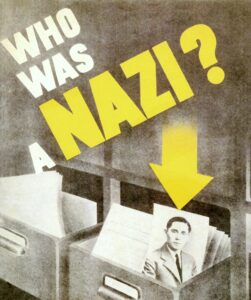
At the Yalta Conference, the U.S., Britain, and the Soviet Union all agree on the denazification of Germany as a goal after the end of World War II.
6.0-1945-who-was-a-nazi-251x300.jpg

August 2​

The Potsdam Declaration lays out plans for cleansing German society of any Nazi influences. This was part of the four political principals for the occupation, known as the four “D”s: Denazification, Demilitarization, Democratization, and Decentralization.

October 10​

Control Council Law no. 2, issued by the Allied Control Council for the “Termination and Liquidation of the Nazi Organization” bans the Nazi Party and all of its affiliated organizations.
6.0-10-10-1945-denazification-germany-1024x837.jpg

JanuarY 12 1946​

Allied Control Council Directive no. 24 calls for the “Removal from Office and from Positions of Responsibility of Nazis and of Persons Hostile to Allied Purposes.”

FebruarY 5​

A Christmas amnesty is declared in the American occupation zone, which benefited primarily “Followers” and those whose annual income before the end of the war had been less than 4,500 reichsmarks.

March 5 1946​

The “Law 104 for the Liberation from National Socialism and Militarism” establishes five categories for classifying people, among other things. They were: 1. Major Offenders, 2. Offenders (activists, militarists, and beneficiaries), 3. Lesser Offenders (probation group), 4. Followers, and 5. Persons Exonerated.
6.0-05-03-1946-gesetz-zur-befreiung-von-nationalismus-und-militarismus-1024x854.jpg

August 6​

The American occupation authorities declare a youth amnesty that covers anyone born after January 1, 1919, unless they were incriminated or charged as “Major Offenders” or “Offenders.” Taken together with the February 5 Christmas amnesty, the youth amnesty reduced by about one-third the number of people still to be processed.

OCtober 12​

Allied Control Council Directive no. 38 takes effect, providing for the “Arrest and Punishment of War Criminals, Nazis, and Militarists and the Internment, Control, and Surveillance of Potentially Dangerous Germans.”

MaY 2 1947​

The French military government issues Ordinance no. 92 for youth amnesty, which covered anyone born after January 1, 1919, excepting only high-ranking Nazi Party functionaries and former members of the SS or the Gestapo.

August 16​

The Soviet military administration releases Order no. 201 on denazification and the complete political cleansing of all public office and industry of “active fascists, militarists, and war criminals,” creating uniform provisions for public denazification proceedings.
6.0-16-08-1947-entnazifizierung-1024x723.jpg

FebruarY 26 1948​

With Order no. 35, the Soviet military administration announces that denazification in the Soviet occupation zone would end on March 10, 1948.

November 17 1949​

The newly-established GDR (East Germany) proclaims a law that waives sanctions and grants civil rights to former members and supporters of the Nazi Party and “officers of the fascist armed forces,” which largely restores the civil rights of anyone incriminated in Nazi activities.

OCtober 15 1950​

The West German parliament adopts a recommendation for a uniform completion of denazification.

MaY 11 1951​

The law regulating the legal status of persons covered by Article 131 of the Basic Law (called the 131 law) is passed by the Bundestag with two abstentions; it marks the end of denazification in West Germany.

OCtober 6 1952​

The law on the civil rights of former officers of the “fascist armed forces,” and former members and supporters of the Nazi Party is announced; with it, prejudicial treatment of people implicated in Nazi activities is legally abolished.

AlliiertenMuseum
Clayallee 135
14195 Berlin

Tuesday – Sunday
10 am – 6 pm
Entry is free
 
Back
Top Bottom