Cost comparison SGR Kenya vs SGR Tanzania

Cost comparison SGR Kenya vs SGR Tanzania

Many have suggested that kenya got shafted and is building an expensive line compared to Ethiopia, but recent pics and updates might suggest otherwise, although not an electric line, it has a larger carrying capacity of 22 million tonnes per year compared to Ethiopia 8.5 million tons and can be upgraded to sustain maximum speeds of 240 km/h after electrification from the current 120km/. Diesel trains bought by Kenya run similar to electric trains of Ethiopia at average of 120 km/h with maximum of 160 km/h
Precisely no a single sound from this things on the move! You can only here the sound of the people, smooth all the way
 
LightYagami soma hiyo attachment! Ethiopia's capacity is 20 mln tonnes per year n Tanzania's is 18 mln tonnes per year! Whereas urs can be electrified, that will cost 15% of the current budget n since the tracks welding design is jointed the speed of 160km/hr is a longer dream than can be a reality. For now ur trains can move at maximum speed of 80km/h for cargo n 100km/h passenger train. U have been massively short changed.
 
LightYagami soma hiyo attachment! Ethiopia's capacity is 20 mln tonnes per year n Tanzania's is 18 mln tonnes per year! Whereas urs can be electrified, that will cost 15% of the current budget n since the tracks welding design is jointed the speed of 160km/hr is a longer dream than can be a reality. For now ur trains can move at maximum speed of 80km/h for cargo n 100km/h passenger train. U have been massively short changed.

Who told you that jointed track can not support speeds of upto 160??
 
Ur welding design for ur rail tracks is not continuous so how can u dare talking of horsepower n powerfulness of the engine if ur rail alone is less smooth in comparison to SGR design in Tanzania
It was you (Or one of you) that brought up claims of your current locomotives having more HP thus more powerful......
Then after I have answered you are telling me not to dare talk about it????

In the grand of things... hata wewe mwenyewe umeshindwa kuponda... ati less smooth.... is that a thing reallly.....

I admit, I would have wished for us to get CWR but its not like we will lose sleep while riding inside the train..... it just becomes white noise when you are inside...

First everyone should understand the difference between the two (continuous wielded rail and Jointed rail)

In CWR, you will either have to use the old central rail in Tz to import these very long tracks and lay them down using the old rail as you go..
like this
CWR 2.jpg
CWR.jpg


Or, you can just lay down segments of the rail just like you would normarly do when laying a jointed rail but instead of using joints, you would then wield the joints together to form a continuous track...like what these guys are doing..


On the other hand, a Jointed track like the one in Kenya, they use metal plates to attach different rail segments leaving a tiny space to allow the rain to expand and contractunder different environs, especially on the bridges that have constrast varrying temperatures

This is how it looks like
mechanical_rail_joint_track_superstructure_permanent_way_pway_cwr_crt_uk.png
r10m0026-photo-06a.jpg
insulated-rail-joint-components.jpg
isolierklebestoesse.jpg
maxresdefaultgg.jpg


in the end, CWR makes a mean vibration magnitute of 1.8Hz while Jointed rail is 2.3Hz difference bieng 0.5Hz
 

Attachments

  • 6544006_orig.png
    6544006_orig.png
    26.2 KB · Views: 293
It was you (Or one of you) that brought up claims of your current locomotives having more HP thus more powerful......
Then after I have answered you are telling me not to dare talk about it????

In the grand of things... hata wewe mwenyewe umeshindwa kuponda... ati less smooth.... is that a thing reallly.....

I admit, I would have wished for us to get CWR but its not like we will lose sleep while riding inside the train..... it just becomes white noise when you are inside...

First everyone should understand the difference between the two (continuous wielded rail and Jointed rail)

In CWR, you will either have to use the old central rail in Tz to import these very long tracks and lay them down using the old rail as you go..
like this
View attachment 502993 View attachment 502994

Or, you can just lay down segments of the rail just like you would normarly do when laying a jointed rail but instead of using joints, you would then wield the joints together to form a continuous track...like what these guys are doing..


On the other hand, a Jointed track like the one in Kenya, they use metal plates to attach different rail segments leaving a tiny space to allow the rain to expand and contractunder different environs, especially on the bridges that have constrast varrying temperatures

This is how it looks like
View attachment 502998 View attachment 502999 View attachment 503001 View attachment 503002 View attachment 503003


in the end, CWR makes a mean vibration magnitute of 1.8Hz while Jointed rail is 2.3Hz difference bieng 0.5Hz
not only vibration also speed limits r there at jointed welded rail.


Joining railsEdit
Rails are produced in fixed lengths and need to be joined end-to-end to make a continuous surface on which trains may run. The traditional method of joining the rails is to bolt them together using metal fishplates(jointbars in the US), producing jointed track. For more modern usage, particularly where higher speeds are required, the lengths of rail may be welded together to form continuous welded rail (CWR).

Jointed trackEdit

Bonded main line 6-bolt rail joint on a segment of 155 lb/yd (76.9 kg/m) rail. Note how adjacent bolts are oppositely oriented to prevent complete separation of the joint in the event of being struck by a wheel during a derailment.
Jointed track is made using lengths of rail, usually around 20 m (66 ft) long (in the UK) and 39 or 78 ft (12 or 24 m) long (in North America), bolted together using perforated steel plates known as fishplates (UK) or joint bars (North America).

Fishplates are usually 600 mm (2 ft) long, used in pairs either side of the rail ends andbolted together (usually four, but sometimes six bolts per joint). The bolts may be oppositely-oriented so that in the event of aderailment and a wheel flange striking the joint, only some of the bolts will be sheared, reducing the likelihood of the rails misaligning with each other and exacerbating the seriousness of the derailment. This technique is not applied universally, European practice being to have all the bolt heads on the same side of the rail. Small gaps which function asexpansion joints are deliberately left between the rail ends to allow for expansion of the rails in hot weather. European practice was to have the rail joints on both rails adjacent to each other, while North American practice is to stagger them.

Because of the small gaps left between the rails, when trains pass over jointed tracks they make a "clickety-clack" sound. Unless it is well-maintained, jointed track does not have the ride quality of welded rail and is less desirable for high speed trains. However, jointed track is still used in many countries on lower speed lines and sidings, and is used extensively in poorer countries due to the lower construction cost and the simpler equipment required for its installation and maintenance.

A major problem of jointed track is cracking around the bolt holes, which can lead to breaking of the rail head (the running surface). This was the cause of the Hither Green rail crash which caused British Railways to begin converting much of its track to Continuous Welded Rail.

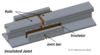
Insulated jointsEdit
Where track circuits exist for signallingpurposes, insulated block joints are required. These compound the weaknesses of ordinary joints. Specially-made glued joints, where all the gaps are filled with epoxy resin, increase the strength again.

As an alternative to the insulated joint, audio frequency track circuits can be employed using a tuned loop formed in approximately 20 m (66 ft) of the rail as part of the blocking circuit. Some insulated joints are unavoidable within turnouts.

Another alternative is the axle counter, which can reduce the number of track circuits and thus the number of insulated rail joints required.

Continuous welded railEdit

Welded rail joint

A pull-apart on the Long Island Rail Road Babylon Branch being repaired by using flaming rope to expand the rail back to a point where it can be joined together
Most modern railways use continuous welded rail (CWR), sometimes referred to as ribbon rails. In this form of track, the rails are weldedtogether by utilising flash butt welding to form one continuous rail that may be several kilometres long. Because there are few joints, this form of track is very strong, gives a smooth ride, and needs less maintenance; trains can travel on it at higher speeds and with less friction. Welded rails are more expensive to lay than jointed tracks, but have much lower maintenance costs. The first welded track was used in Germany in 1924 and the US in 1930[11] and has become common on main lines since the 1950s.

The preferred process of flash butt welding involves an automated track-laying machine running a strong electrical current through the touching ends of two unjoined pieces of rail. The ends become white hot due to electrical resistance and are then pressed together forming a strong weld. Thermite welding is used to repair or splice together existing CWR segments. This is a manual process requiring a reaction crucible and form to contain the molten iron. Thermite-bonded joints are seen as less reliable and more prone to fracture or break.[citation needed]

If not restrained, rails would lengthen in hot weather and shrink in cold weather. To provide this restraint, the rail is prevented from moving in relation to the sleeper by use of clips or anchors. Attention needs to be paid to compacting the ballast effectively, including under, between, and at the ends of the sleepers, to prevent the sleepers from moving. Anchors are more common for wooden sleepers, whereas most concrete or steel sleepers are fastened to the rail by special clips that resist longitudinal movement of the rail. There is no theoretical limit to how long a welded rail can be. However, if longitudinal and lateral restraint are insufficient, the track could become distorted in hot weather and cause a derailment. Distortion due to heat expansion is known in North America as sun kink, and elsewhere as buckling. In extreme hot weather special inspections are required to monitor sections of track known to be problematic.

After new segments of rail are laid, or defective rails replaced (welded-in), the rails can be artificially stressed if the temperature of the rail during laying is cooler than what is desired. The stressing process involves either heating the rails causing them to expand,[12]or stretching the rails with hydraulicequipment. They are then fastened (clipped) to the sleepers in their expanded form. This process ensures that the rail will not expand much further in subsequent hot weather. In cold weather the rails try to contract, but because they are firmly fastened, cannot do so. In effect, stressed rails are a bit like a piece of stretched elastic firmly fastened down.

CWR rail is laid (including fastening) at a temperature roughly midway between the extremes experienced at that location. (This is known as the "rail neutral temperature"). This installation procedure is intended to prevent tracks from buckling in summer heat or pulling apart in winter cold. In North America, because broken rails (known as a pull-apart) are typically detected by interruption of the current in the signaling system, they are seen as less of a potential hazard than undetected heat kinks.


An expansion joint on the Cornish Main Line, England
Joints are used in continuous welded rail when necessary, usually for signal circuit gaps. Instead of a joint that passes straight across the rail, the two rail ends are sometimes cut at an angle to give a smoother transition. In extreme cases, such as at the end of long bridges, a breather switch(referred to in North America and Britain as anexpansion joint) gives a smooth path for the wheels while allowing the end of one rail to expand relative to the next rail.
 
LightYagami soma hiyo attachment! Ethiopia's capacity is 20 mln tonnes per year n Tanzania's is 18 mln tonnes per year! Whereas urs can be electrified, that will cost 15% of the current budget n since the tracks welding design is jointed the speed of 160km/hr is a longer dream than can be a reality. For now ur trains can move at maximum speed of 80km/h for cargo n 100km/h passenger train. U have been massively short changed.
I have read the pdf word by word, and now more than ever, I can confidently say that Tanzania rail has nothing on Kenya!!!!

Ethiopia rain is of class 2 chinese standars(meaning using lighter metal alloy than can support maximum of 4000tones axle weight ------- This translates to carrying average of 20 Million tonnes a year...

The Tz SGR built by turkey is using an american standard....... but is designed for maximum of 18 Million tonnes per year only!!! thats the maximum kabisa!!!!!

Kenyas SGR is built using class 1 Chinese standard for heavy tonnage, designed to carry 20-35 Million tonnes a year,

------ SO the tanzania rail may be cheaper but when you look at it really, it doesnt matter, when you look at the bigger picture its not that cheap after all....... e.g if I may explain:
Tanzania cargo from Dar port per anum is approx 16 Miilion tonnes of cargo Dar port starts to come under scrutiny as cargo volume falls

I dont know about Rwanda, but lets assume rwanda and burrundi import about 1 million tonnes a year... So if Tz were to eventually transport 60 % of her goods (10 million tonns) through the SGR... It will leave the Tz-SGR only an extra space of 8 Million for transit..... Between rwanda, DRC,and UGanda that is not enough, alafu eti mnataka mpaka market ya S.Sudan...hahahaha even if Kenya were to disapear from the face of the earth and you were to get all the markets in the region without competition, your SGR will be unequipped to serve those markets......
From the PDF on the last paragraph, Uganda imported 10Mln tonnes of Cargo through Kenya, Tz SGR simply wont be able to take this cargo through her SGR evein if Kenya were to freely give her the responsibility


Onthe other hand, Mombasa port handled 27mln tonnes of cargo in 2016 .....Mombasa's port traffic up 2.4 percent in 2016 | News by Country | Reuters
The SGR itself was designed to handle even 35mln tonnes a year.... plenty of room for the rail to serve Kenya comfortably even if the economy were to expand rapidly in the next decade..... we wont need to build anything else....


Ohhh, and BTW, the report you brought yourself clearly asserts that Uganda is building the rail through nothern corridor first before anywhere else
 
I have read the pdf word by word, and now more than ever, I can confidently say that Tanzania rail has nothing on Kenya!!!!

Ethiopia rain is of class 2 chinese standars(meaning using lighter metal alloy than can support maximum of 4000tones axle weight ------- This translates to carrying average of 20 Million tonnes a year...

The Tz SGR built by turkey is using an american standard....... but is designed for maximum of 18 Million tonnes per year only!!! thats the maximum kabisa!!!!!

Kenyas SGR is built using class 1 Chinese standard for heavy tonnage, designed to carry 20-35 Million tonnes a year, it can even add more because the maximum limit is even higher!

------ SO the tanzania rail may be cheaper but when you look at it really, it doesnt matter, when you look at the bigger picture its not that cheap after all....... e.g if I may explain:
Tanzania cargo from Dar port per anum is approx 16 Miilion tonnes of cargo Dar port starts to come under scrutiny as cargo volume falls

I dont know about Rwanda, but lets assume rwanda and burrundi import about 1 million tonnes a year... So if Tz were to eventually transport 60 % of her goods (10 million tonns) through the SGR... It will leave the Tz-SGR only an extra space of 8 Million for transit..... Between rwanda, DRC,and UGanda that is not enough, alafu eti mnataka mpaka market ya S.Sudan...hahahaha even if Kenya were to disapear from the face of the earth and you were to get all the markets in the region without competition, your SGR will be unequipped to serve those markets......
From the PDF on the last paragraph, Uganda imported 10Mln tonnes of Cargo through Kenya, Tz SGR simply wont be able to take this cargo through her SGR evein if Kenya were to freely give her the responsibility


Onthe other hand, Mombasa port handled 27mln tonnes of cargo in 2016 ..... The SGR itself was designed to handle even 35mln tonnes a year.... plenty of room for the rail to serve Kenya comfortably even if the economy were to expand rapidly in the next decade..... we wont need to build anything else....


Ohhh, and BTW, the report you brought yourself clearly asserts that Uganda is building the rail through nothern corridor first before anywhere else
The total tonnage is irrelevant in comparison to how goods get to another point in shortest time. U should ask urself whether ur SGR can bring returns as far as the cost n paying back the loan r considered! Uganda parliament has flatly rejected ur grade one rail as they see unnecessary cost!

Sent from my SM-J320F using JamiiForums mobile app
 
not only vibration also speed limits r there at jointed welded rail.
.

LightYagami soma hiyo attachment! Ethiopia's capacity is 20 mln tonnes per year n Tanzania's is 18 mln tonnes per year! Whereas urs can be electrified, that will cost 15% of the current budget n since the tracks welding design is jointed the speed of 160km/hr is a longer dream than can be a reality. For now ur trains can move at maximum speed of 80km/h for cargo n 100km/h passenger train. U have been massively short changed.

Hehe, speed limits will only be an issue when you cross the 300KM/hr mark..... bullet trains wont be able to run on the kenya SGR.......... but since non of us will be using bullets trains, what matters on the CWL and the jointed rail on our countries is vibration... anyway, about the speed, there is a vedio of driver in a private car along the Msa-sairobi highway who was driving at 120km/hr while chasing the persenger train running alongside the road and the train was still passing him.....
During testing the SGR persenger locomotive reached a maximum of 158Km/hr!!!! so hio sijui short change, hio ni change yako!


Here is a picture taken while they were conducting testing on the persenger locomotive....... look at the speed encircled ...Thats 134km/hr if you are not seenig clearly!
sgr 134 kmhr.jpg
sgr test.jpg
U2XfAu1.jpg
gc9UR65.jpg
VScDCOj.jpg
 
h
The total tonnage is irrelevant in comparison to how goods get to another point in shortest time. U should ask urself whether ur SGR can bring returns as far as the cost n paying back the loan r considered! Uganda parliament has flatly rejected ur grade one rail as they see unnecessary cost!

Sent from my SM-J320F using JamiiForums mobile app
have yours started,ama ni ile udaku tu...😀
 
Old meter gauge in the background carrying petrolium and LPG
No title(52).jpg


I count about 13 wagons enough for 1000
1521185504580827.jpg
 
Back
Top Bottom