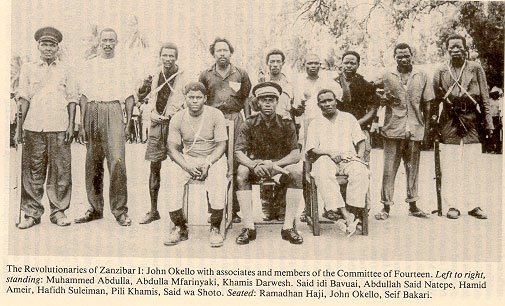
Msijiridhishe kwa hiyo contemporary Zanzibar history miaka mingi BAADA ya mapinduzi ya 1964.
Hata wale wanaoandamana huko Uingereza na Marekani ni uzao wa waliopinduliwa 1964.
Hilo halina ubishi.
Mzizi wa fitna ni nia ya CUF kuwabeba waliopinduliwa na kurudisha classes za pre '64.
Watasema maneno matamu lakini nia yao ni dhahiri.
Wana CCM wengi wa Z'bar ambao kiukweli ni ASP hawataki kurudishwa utumwani, huo ndo ukweli.
You are just an Ignorant pathetic stupid boy you know nothing there were no classes in Zanzibar if you dont know about it slavery was abolished since 5 April 1897. At 118 years the age even your grandpa was not yet net born there was no more slavery in the East Coast of Africa. In 1890 Zanzibar and East Africa came under the British Rule and Hegemony. So since that period until Dec 10, 1963 Zanzibar was ruled by HM British Government Chief Minister under the so famous Sultan a head of State who could not approve even budget for his palace expenditure.
Ikulu Zanzibar had a UK flag on its staff not the Sultans flag.
Check this time line:
1884-AD-- The German flag was first raised in East Africa.-
Dr Karl Peters landed at Bagamoyo and persuaded a number of chiefs to sign treaties surrendering large tracts of mainland to his Society for German Colonisation.-
Kaiser Wilhelm I convened an international conference in Berlin where it was agreed that no nation would annexe any part of Africa without giving due notice. The day after this, the Kaiser announced that Germany had taken under her imperial protection all the territories (about 60,000 square miles) newly acquired by Dr Peters on the mainland. -
1885-AD-- The German Emperor gave a Charter to the German East Africa Company to administer the territories they laid claim to on the mainland. -
28th May: Commercial Treaty between Italy and Zanzibar signed. -
30th May: Commercial Convention between Belgium and Zanzibar signed. -
7th August: German blockade of Zanzibar. A squadron of five German warships anchored off Zanzibar and delivered an ultimatum to Seyyid Barghash to recognise German occuptaion of the Territory which came to be known as German East Africa as well as of the Sultanate of Witu on the coast north of Mombasa at the mouth of the Tana river.-
17th October: Lt. Col. (afterwards Earl) Kitchener, appointed British Commissioner on the Zanzibar Boundary Commission. -
December: Britain and Germany met in Zanzibar and agreed to recognise the Sultan?s authority over the islands of Zanzibar, Pemba, Mafia and Lamu and over a coastal strip about 700 miles long and 10 miles wide, stretching from the Rovuma to the Tana. North of the Tana the Sultan would still hold the towns of Barawa, Merka, Mogadishu and Warsheik. -
1886-AD-- 8th November: Zanzibar adhered to the Berlin Treaty. The Delimitation Treaty defined the British and German spheres of influence in East Africa.-
The hinterland behind the Sultan's coastal strip was divided into two spheres of influence: the northern part from the Fumba river to the Tana was allotted to the British. The southern part from the Umba to the Rovuma was allocated to the Germans.-
The two powers had divided the Sultan?s Empire between them. From this point on Zanzibar?s control of the mainland was virtually nonexistent. -
1887-AD-- 9th July: Queen Victoria?s Golden Jubilee festivities in Zanzibar. At 4 pm the foundation stone of the Ithnashiri Dispensary was laid by Tharia Topan, a merchant in the city. A golden trowel was used and the stone laid to the music of the Sultan?s band.-
11th August: Commercial Convention signed between Austria and Zanzibar. -
1888-AD-- 26th March: Seyyid Barghash died, having been ill for some years of consumption and elephantiasis. He had reigned for 18 years and was succeeded by Seyyid Khalifa bin Said. (Reigned 1888-1890). Khalifa had been imprisoned by Barghash in a dungeon under the palace for six years under suspicion of intrigue and was ?somewhat weak in the head?. -
16th August: The German East Africa Company leased the coastal strip from the Umba to the Rovuma from Seyyid Khalifa, largely through the offices of Carl Peters. Resistance began in Pangani against the oppressive rule of the German East Africa Company and this soon spread along the whole coast, fomenting the "Maji Maji" rebellion. -
The leaders were Abushiri bin Salim, an Arab, and Bwana Heri, a Mzigua. The resistance was crushed by the Germans after two years, during which time there was considerable unrest and some missionaries and other foreigners were killed. -
3rd September: The Imperial British East Africa Company received a Charter from the British Government. The British East Africa Protectorate and the Uganda Protectorate came into being.-
2nd December: Blockade of Zanzibar coast by British warships.
1889-AD-- 31st August: Agreement for the administration of part of Zanzibar's Mainland Territories by the British Imperial East Africa Company. -
13th September: Edicts were issued by Sultan Khalifa freeing all children of slaves born after 1st January, 1890.-
1st October: Blockade of Zanzibar coast raised. -
1890-AD-- 13th February: Seyyid Khalifa bin Said died. Though normally in good health, he had been visiting his country palace at Chukwani for a change of air. After his return from a few hours? shooting he was seized with a high fever and soon afterwards he died of heat apoplexy at the age of 36.-
Seyyid Ali bin Said acceded to the throne of Zanzibar. (Reigned 1890-1893). -
14th June: Agreement between Zanzibar and Great Britain in respect of making Zanzibar a British Protectorate. -
2nd July: General Act of Brussels Conference providing for the suppression of the slave trade by sea and land and for the restriction of the import of alcoholic liquor and of firearms, which the slavers had supplied to the mainland chiefs in exchange for slaves. Procedures were laid down for the searching of vessels on the high seas, compelling them to fly a national flag and to provide lists of crew and passengers. -
20th October: Sir Richard Burton, explorer, died, 69 years of age.
-
4th November: A British Protectorate over Zanzibar and Pemba was proclaimed. The Protectorate was recognised by Germany in exchange for the Island of Heligoland in the North Sea.- Germany also agreed to give up her protectorate at Witu and all claims to territory in Uganda. France accepted the Protectorate on recognition by Great Britain of the French Protectorate over Madagascar.- Thus, the
Albusaid Sultancy of Zanzibar lost its power. The post of First Minister to the Sultan was created and Sir Lloyd Mathews filled the post. -
27th December:-- Germany paid 4 million gold marks - about ?200,000 - to Zanzibar for the coast (with its hinterland) between the rivers Umba and Rovuma and the Island of Mafia. -
1891-AD-- A constitutional government was established with Sir Lloyd Mathews as First Minister of the Sultan. The Sultan's Civil List was fixed at 250,000 rupees a year. The first budget was drawn up. -
1892-AD-- 1st February: Zanzibar was declared a Free Port and the 5% ad calorem duty was abolished. (This step was taken to counteract the trade competition offered by the ports of the neighbouring German East Africa.) -
The Zanzibar Gazette was first published. -
12th August: Concession of Benadir Ports to Italy. -
1893--AD- 5th March: Seyyid Ali bin Said died. He was the last of the sons of the great Sultan, Seyyid Said, to occupy the throne of Zanzibar. -
First attempt by Seyyid Khaled, the obstinate and proud young eighteen year old son of Barghash, to occupy the palace and usurp the throne. He was taken away to his own house by the British Consul General, Sir Rennell Rodd, Sir Lloyd Mathews and an escort of marines from H.M.S. Philomel and H.M.S. Blanche. -
Seyyid Hamed bin Thuwain, eldest son of the eldest living son of Sultan Said, Thuwain, Sultan of Oman, acceded. (Reigned 1893-1896). -
At the command of his uncle the Sultan, Seyyid Khalifa bin Harub came to Zanzibar for the first time at the age of 13. The same year Khalifa, accompanied by his brother-in-law Seyyid Ali bin Hammound, went on a pilgrimage to Mecca. -
Italy bought the towns of Barawa, Merka, Mogadishu and Warsheik and the adjacent Benadir coast from the Sultan for a cash payment. -
1895-AD-- 14th December:-- Agreement respecting Zanzibar's mainland territories. The Imperial British East Africa Company came to an end, its territory coming under direct British control as British East Africa (later Kenya) on condition that the Zanzibar Government received ?44,000 annually as rent for it. -
Britain forced the Sultan's Government to pay ?200,000 to the Imperial British East Africa Company as compensation for its territory on the mainland - even though Britain, not Zanzibar was gaining control of it again. -
Therefore the ?200,000 which Germany had paid to Zanzibar in 1890 for German East Africa, was used to pay for the return of British East Africa - to the British Government. In return ?6,000 a year was to be paid to the Sultan?s government as interest of 3% on this ?200,000. -
In addition, the Company received a further ?50,000 from the British Government in compensation. -
1896-AD-- 25th August: Death of Seyyid Hamed bin Thuwain. -
The same day, Khaled bin Barghash moved into the palace with many followers and attempted for the second time to usurp the throne. With 2000 men behind him, including the Sultan?s bodyguard, he took a task force of 60 men and climbed into the palace through a window. He declared himself Sultan and raised the Sultan's plain red flag. -
27th August 9.00 am: Bombardment of the Palaces by the British fleet which was anchored 150 yards off the town. This included: the warship H.M.S. Philomel under Captain O?Callaghan; the first-class cruiser H.M.S. St. George - flagship of Rear-Admiral Rawson; two gunboats: H.M.S. Thrush and H.M.S. Sparrow and the third-class cruiser H.M.S. Racoon. -
The firing lasted for only forty minutes. The Sultan's wooden armed corvette, the Glasgow, returned fire and was sunk. The guns and troops in the Palace square received a direct hit immediately and the smaller of the Palace buildings plus the adjoining Harem Palace were demolished. -
Seyyid Khaled's casualties were about five hundred killed and wounded. The British had one casualty. -
Khaled escaped from the burning Palace on horseback and took refuge in the German Consulate. The Germans escorted him to a waiting gunboat and took him away to Dar es Salaam where he lived until the defeat of the Germans in East Africa during the First World War. Then he was sent to St Helena and later to the Seychelles until in 1925 he was allowed to return to Mombasa where he remained until his death in 1927, aged 49. -
Seyyid Hamoud bin Muhammad acceded to the throne of Zanzibar. (Reigned 1896-1902). -
1897-AD-- 5th April: Slavery in Zanzibar was totally abolished after many Decrees, the first of them enacted by Seyyid Said in 1822. -At this time there were 50 - to 60,000 slaves in Zanzibar. By the end of the year only about 2,000 of them had claimed their freedom. -
1899-AD-- December: The 5% ad calorem customs tax was re-imposed. -
1901-AD-- 100,000 pounds worth of Zanzibar 3% Debentures were issued in London at par. Principal repayable not later than 1st October 1931. -
4th October: Sir Lloyd Mathews died in Zanzibar of fever, after living there for 20 years. He was buried at the English Cemetery in Ziwani and a Monument was erected