GE2025 TEC: Ewe Mungu, Tuma Roho wako, afanye upya uso wa Nchi kabla ya Uchaguzi Mkuu 2025
You are using an out of date browser. It may not display this or other websites correctly.
You should upgrade or use an alternative browser.
You should upgrade or use an alternative browser.
GE2025 TEC: Ewe Mungu, Tuma Roho wako, afanye upya uso wa Nchi kabla ya Uchaguzi Mkuu 2025
- Thread starter Doctor Mama Amon
- Start date
-
- Tags
- mungu tec uchaguzi mkuu 2025
Matukio, Taarifa, Habari na Mijadala ya Wananchi WAKATI wa Mchakato wa Uchaguzi Mkuu 2025


Doctor Mama Amon
Platinum Member
- Mar 30, 2018
- 2,311
- 3,513
- Thread starter
- #102
Huyo Mungu wanayemuamini Wakristo na wengi wengine, mjuzi wa yote, mwenye uwezo wote na upendo wote, angekuwapo kweli, kusingekuwa na haja ya kumuomba kitu.
Angewapa viumbe wake mazuri yote wanayohitaji bila kuombwa, kungekuwa hakuna haja ya kuomba chochote. Na mengine yasiyofaa kuombwa watu wasingejua hata kuwa na tamaa ya kuyaomba.
Ukiona mtu anaomba Mungu tu, huo ni ushahidi Mungu mjuzi wa yote, mwenye uwezo wote na upendo wote hayupo.
Kama kuna kazi ya kuifanya kuondoa watawala dhalimu, au kubadilisha mifumo, ifanyieni kazi nyie wenyewe msimtegee Mungu ambaye hayupo awafanyie kazi mnayotakiwa kuifanya nyie wenyewe.
Watawala dhalimu wakisikia mnaishia kuomba Mungu wanafurahi sana kwa sababu wanajua habari ya Mungu ni silaha ya kuwapumbaza watu wasipiganie chao wamuachie Mungu awasaidie.
Kuomba Mungu badala ya kufanya kazi unayotakiwa kufanya wewe mwenyewe ni ku abdicate responsibilities.
A PHILOSOPHICAL DEFENSE OF PETITIONARY PRAYERS: A RESPONSE TO KIRANGA
I. INTRODUCTION
Prayer seems to be a prominent feature of every religion. When people pray, they attempt to contact/communicate with special persons or entities, such as a God or gods, or dead relatives, or exemplary human beings who are believed to occupy some special status.
People pray for all kinds of reasons. Sometimes people pray in order to give thanks, sometimes to offer praise and adoration, sometimes to apologize and seek forgiveness, and sometimes to ask for things.
A petitionary prayer, at its core, is a form of prayer where individuals make specific requests of God, to mitigate perceived evils and bring about desired goods, either for themselves or others.
The logic behind it stems from a belief that God is both powerful and benevolent, and that approaching Him with sincere requests can lead to positive outcomes.
Historically, the philosophical puzzles concerning petitionary prayer that have received most attention have arisen in connection with the traditional monotheism shared by Judaism, Christianity, and Islam.
According to traditional monotheism, God knows everything that can be known (omniscient), can do everything (omnipotent), is perfectly good (omnibenevolent), impassible (unable to be affected by an outside source), immutable (unchanging), and free.
On this view, if God actually answers prayers that petition him for something, then it seems he is willing to withhold some good(s) from the world unless and until someone prays for those goods. But how is this compatible with His benevolence?
On the other hand, if God is dedicated to providing every good to us that we may need, it would seem that He would provide these to us even if we did not pray for them. But if so, it would appear that petitionary prayer is pointless.
If so, many people ask, does it make sense to offer petitionary prayer to God with the expectation that such prayer might influence God to bring about some good he otherwise would not have brought about?
That is, why would God make us ask for some good He might supply, and why would it be right for God to withhold that good unless and until we asked for it?
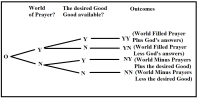
Given a specific good that can be given by God, we have four scenarios to consider.
A world in which people pray and another in which people do not pray. The world in which people pray has two possibilities, answered prayers and unanswered prayers.
And a world in which people do not pray has two possibilities too, the availability of the said good and unavailability of the said good. The following diagram clarifies:
Against this background, at least in regard to the desired good, it would seem that a world in which God simply supplied all appropriate goods to the world – without requiring us to pray for them, would be preferable to one in which God answers prayers, but allows the world not to enjoy all of the goods appropriate to it unless and until someone prays for them.
Let us call the first, the World-Minus-Prayer (WMP) and the second, the World-Plus-Prayer (WPP).
On this view, for petitionary prayer to be efficacious as “causes of certain effects,” it really must be the case that at least some prayers induce God to some action that He would not take were it not for the prayer.
Otherwise, the world in question reduces to some version of WMP, where God would do everything, even people don’t pray for anything.
So, our problem is to determine what good, weightier than the good of getting what one asks for because one asked for it, might be instantiated in WPP that is not instantiated in WMP.
FORMAL PRAYER PARADOX STATEMENT
A paradox is a set of statements which cannot all be true simultaneously.
It is along this line that, many thinkers have questioned whether petitionary prayer is coherent with the basic tenets of Christian theism, particularly divine omniscience, omnipotence, and omnibenevolence.
They ask: “Can an Omniscient God, who Knows the future, find The Omnipotence to Change His future mind?”
They puzzle can be summarized by using the following five-point syllogism:
- God is omniscient (omniscience premise).
- God is omnibenevolent (omnibenevolence premise).
- God is omnipotent (omnipotence premise).
- God is immutable (immutability premise).
- Petitionary prayer might influence God to bring about some good he otherwise would not have brought about (the influence premise).
That is, it seems that affirming the influence premise of petitionary prayer requires either that God is somehow:
- informed by the prayer, contra omniscience premise,
- influenced to prefer some good he otherwise would not, contra omnibenevolence premise, or
- increased in power, contra omnipotence premise, or
- Changed one’s mind, contra immutability premise.
Denying Some Premises
One way to elude the influence premise is to deny divine omnibenevolence, omnipotence, omniscience, immutability, or the influence aim.
First, one might maintain that petitionary prayer may somehow inform God. This would elude the influence premise, but at the cost of denying divine omniscience.
Two, one might claim that God could be influenced to desire to bring about a good he otherwise would not have desired.
This would elude the influence premise, but at the cost of denying divine immutability.
Also, this would elude the influence premise, but at the cost of denying divine omnibenevolence, understood to mean that God wills a set of goods than which no other set of compossible goods is morally better.
Three, one might claim that God lacks the sheer power to bring about the good(s) that he wills to bring about, but petitionary prayer somehow increases God’s power.
This would elude the influence premise, but at the cost of denying divine omnipotence.
Further, such a move would raise the puzzling question as to how prayer could increase God’s power.
Four, one may ignore to consider a denial or significant modification of any of premises (1)–(4) to be a live option.
Instead, to address the influence premise one may deny the influence premise.
At this point, some may deny the usefulness of petitionary prayer altogether, as Mr. Kiranga does.
Many others, however, deny the influence premise by adopting the view that petitionary prayer does not influence God but may positively affect the human who prays or hears such prayer, say, by bringing human desires more in line with God’s will and in other ways.
This follows the common adage that prayer does not change God, but it changes us.
Indeed, for some Christian theists, it is metaphysically impossible that prayer could affect God or have any real influence on what God brings about.
Five, one may remain committed to all five premises, including affirming the influence premise, as the view most consistent with Christian practice.
In fact, numerous instances in Scripture appear to support the view that prayer might make a difference regarding whether or not God brings about some good (e.g., 2 Chron 7:14; Mark 9:29; Luke 11:1–13).
On this view, instead of denying any premises of the influence premise, one might argue that the four premises are not inconsistent.
One might attempt to show this by positing that there is some other premise by which the influence aim can be consistently affirmed alongside divine omniscience, omnibenevolence, and omnipotence.
For example, in addition to premises (1)–(5), one could posit:
(6) God’s providence is ordered in such a way that there is some good that God perfectly knows about, prefers to bring about, and possesses the sheer power to bring about, yet God has some reason(s) compatible with his perfect goodness such that he will not bring about that good without the “influence” of petitionary prayer.
One inclined in this direction might thus affirm (6) while also believing that humans should not expect to be in a position to know God’s reason(s) for refraining from bringing about such good(s) in the absence of petitionary prayer.
Furthermore, one might propose an additional premise that is compatible with some of the foregoing proposals. Specifically, one might posit that:
(7) There is some factor or set of factors that morally prevents God from bringing about what he already prefers to bring about, but petitionary prayer makes a difference relative to the preventing factor(s).
In some scenario, God might otherwise prefer to bring about a particular good (or prevent a particular evil) but in some cases doing so might be against the rules of engagement unless God is petitioned to do so.
This might be put in the form of the following additional premise:
(8) It might be that God has committed himself to rules of engagement in a cosmic conflict context such that God is morally prevented from bringing about some good(s) that he is aware of, otherwise would like to bring about, and possesses the sheer power to bring about, unless he is petitioned to do so by an appropriate party or parties.
On this understanding, the influence premise is consistent with divine omniscience, omnibenevolence, and omnipotence.
More specifically, it is consistent with omniscience, because it is consistent with the belief that God is always entirely aware of the object of petition.
It is consistent with omnibenevolence, because it is consistent with the belief that God already otherwise prefers to bring about the potential good that is the object of petition.
And it is consistent with omnipotence, because it is consistent with the belief that God essentially possesses the sheer power to bring about the potential good that is the object of petition.
SUMMARY AND CONCLUSION
The above discussion has shown that, it is not illogical to engage in petitionary prayers, simply because of the so-called prayer paradox, which is represented by the following five-point syllogism:
- God is omniscient (omniscience premise).
- God is omnibenevolent (omnibenevolence premise).
- God is omnipotent (omnipotence premise).
- God is immutable (immutability premise).
- Petitionary prayer might influence God to bring about some good he otherwise would not have brought about (the influence premise).
THE EVIDENTIAL OBJECTION FOR PETITIONARY PRAYER
This objection asks and negatively answers the question, "Does God answer petitionary prayers?"
But, the formulation of this question is ambiguous. Are we asking whether God "always" or "typically" or "sometimes" or "ever" answers prayers?
The phrasing will make a difference in how one would go about trying to answer the question under each of these scenarios.
The answer to the question "Does God ever answer petitionary prayers?" will be affirmative even if there was or will be only one prayer in all human history (including the future) that has been answered.
Moreover, in order to explore whether there are petitionary prayers that have, in fact, been answered by God we first need to characterize the phenomenon of "answered petitionary prayer".
So, what is an answer to petitionary prayer? A simple characterization such as the following will not suffice:
"A’s petitionary prayer for a result E is answered by God if and only if A prayed for E to happen and then E actually happened".
If I pray that the sun will shine tomorrow, the fact of the sun shining tomorrow does not prove, or even indicate, that God has answered my prayer.
That is because the sun might have shone whether or not I prayed for it. It seems probable, or at least possible, that my prayer does not lead God to make the sunshine.
The fact that the sun shines is better explained by appealing to natural principles and causes than by appealing to my prayer and God taking it into account.
Moreover, another, and more acute, problem with such a proposal is that there are possible cases (whether probable or not) in which the right side of the account is satisfied and the left side is not.
Therefore, it cannot serve as an account at all. A more sophisticated characterization of ‘answered petitionary prayer’ is thus required, one that includes a counterfactual condition. Instead, a precisely characterization is proposed to be the following:
"A’s petitionary prayer for an object E is answered by God if and only if God’s desire to bring about E just because A requested it plays an essential role in a true contrastive explanation of God’s bringing about E rather than not."
This characterization includes the counterfactual element but also much more.
In general, to say God answered prayer is to say that the full causal explanation of the occurrence of the state of affairs requested by the petitioner will include, among other things, God responding to the petition itself.
Thus framed, the evidential challenge for petitionary prayer becomes obvious. We have to investigate whether God has ever answered, or will answer, a petitionary prayer.
REBUTTAL TO THE EVIDENTIAL OBJECTION FOR PETITIONARY PRAYER
The burden of proof to justify a negative answer to such a question would thus be extremely heavy, so heavy that it could never be satisfied.
Attachments

baz kaiza
JF-Expert Member
- Jan 27, 2015
- 14,971
- 18,641
Polepole sio mwana CCM ni Padre Kitima alishambulia serikalini Ilichukua hatua gani? Je watu kusali ni kosa?Kuna namna Waislamu nao wanapasws kujiandaa kwa ajili ya kugawana hii nchi, ni dhahiri TEC wamedhamilia kabisa kumuonea na kumdhulumu Haki yake ya kuongoza huyu mama. Hilo liko wazi kabisa na yule polepole ni mtu wao wanayemuwezesha na kumpa jeuri ya kufanya anayofanya......kinachokera hawana sababu nyingine zaidi ya udini.
baz kaiza
JF-Expert Member
- Jan 27, 2015
- 14,971
- 18,641
RomaNchimbi dhehebu gani?

GAGNANT
JF-Expert Member
- Jun 24, 2021
- 1,282
- 2,584
Mimi na familia yangu ni wakatoliki.View attachment 3438148
Rais wa Baraza la Maaskofu Katoliki Tanzania (TEC), Askofu Wolfgang Pisa.
Ujumbe Mkuu wa TEC Siku ya tarehe 23 Agosti 2025: “Waipeleka roho yako, Wanaumbwa upya, Nawe waufanya upya uso wa nchi” (Zaburi 104:30)
Sasa ni wazi kwamba Baraza la Maaskofu Katoliki Tanzania limeamua kufuata nyayo za Mtakatifu Fransis wa Assiz, Mwalimi Julius Kambarage Nyerere, Baba wa Taifa la Tanzania, pamoja na Papa Yohane Paulo II, kuhusu ajenda ya kudumu ya kupigania haki na amani.
- Wameandaa Sala na Mfungo wa kuombea haki na amani nchini
- Watafafanua tamko kwamba "amani ni tunda la haki, usawa, ukweli, mshikamano na ustawi wa wote.”
- Watataka “chuki ishindwe na upendo”
- Watashawishi “kisasi kiuachie nafasi msamaha”
- Watahimiza “ugomvi ugeuzwe kuwa urafiki.”
- Watahamasisha "maadui warejee kwenye mazungumzano"
- Watahanikiza "wapiganao wapeane mikono"
Katika sala yake ya kuombea haki na amani, Mtakatifu Fransis (1182–1226), mzaliwa wa Italia, anamwomba Mungu amfanye “chombo cha amani” ili aweze kugeuza chuki kuwa upendo, majeraha kuwa msamaha, mashaka kuwa imani, kukata tamaa kuwa matumaini, giza kuwa nuru, na huzuni kuwa furaha.
Mwalimu Nyerere, mwaka 1961, alizindua Mwenye wa uhuru ili alama inayoonekana kuhusu ndoto yake ya “kugeuza giza la dhuluma kuwa nuru ya haki” katika Tanzania mpya.
Naye Papa Yohane Paulo II, wakati wa ziara zake nchini Poland za mwaka 1979 hadi 1989, alitumia kaulimbiua iliyobeba maneno ya Mzaburi kufanikisha ajenda ya “kuufanya upya uso wa nchi” kwa kuhubiri haki na amani nchini humo. Mkakati wake ulianzia kwenye maneno ya Zaburi yasemayo kwamba, “Waipeleka Roho yako Ee Mungu, nawe waufanya upya uso wa nchi.” (Zaburi 104:30).
Huu ndio ujumbe unaosindikiza Mafungo ya Kanisa katoliki kwa ajili ya “Kuomba Haki na Amani” nchini Tanzania utakaohitimishwa tarehe 23 Agosti 2025.
Kwa ufupi, tunaweza kusema kwamba, TEC wanatembea katika nyayo zote hizi.
Tarehe 08 Agosti 2025, Sekretarieti ya Baraza la Maaskofu Katoliki Tanzania, yenye Makao yake Makuu Jijini Dar es Salaam, imetoa mwongozo wa kitaifa, wenye rejea namba TEC/P/05/08/25 05/08/2025, kuhusu utaratibu wa kutekeleza ratiba ya “Ratiba ya Mfungo Kuomba Haki na Amani Nchini Tarehe 23 Agosti 2025.”
Mwogozo huo unatokana na Barua ya Maaskofu Katoliki ya tarehe 19 Juni 2025 iliyotoa wito wa kuandaliwa kwa siku maalum ya “sala na mfungo” kwa ajili ya kuombea “amani” ambayo ni “tunda” la “haki, usawa, ukweli, mshikamano na ustawi wa wote.”
Pamoja na utaratibu ambao kila Jimbo litajipangia katika kutekeleza wito huo, mwongozo wa sasa unatoa mapendekezo ya kitaifa yatakayotumika kama utaratibu wa kuiadhimisha siku hii maalum kwa sala na mfungo.
Mwongozo huo kutoka Sekretarieti ya Baraza la Maaskofu Katoliki Tanzania, umesainiwa na Padre Alister Makubi, Mkurugenzi Wa Uchungaji wa TEC.
Viongozi wote wa Kanisa Katyoliki nchi nzima wanaagizwa kutekeleza mkakati wa Kanisa Katoliki wa kuombea Haki na Amani kwa kutumia mwongozo wa “Misa Namba 30.”
Misa hii inapatikana kwenye kitabu kinachoitwa “Misale ya Waumini,” zu tusema “Misale ya Kiroma,” ukurasa wa 931-932.
Kurasa hizi ndizo zinabeba ujumbe rasmi wa Kanisa Katoliki kwa Waumini wote na Taifa kwa Ujumla. Ujumbe hii umetapaa kwenye salama kadhaa zikiwemo cifuatazo:
Sala ya kuanza ibada inabeba maneno yanayomwomba Mungu, awape “amani” wamngojao na ukatuongoze “kwenye nijia ya haki”; kwamba, kwa vile amefunua kwamba “wapatanishi wataitwa wana wa Mungu,” basi asiache mwaka huu upite bila ahadi hii kutumia.
- Sala ya kuanza ibada,
- Sala ya kuombea dhabihu,
- Sala ya Ekaristi ya Upatanisho,
- Wimbo wa Komunyo na
- Sala baada ya Komunyo.
Aidha, Sala ya kuanza ibada inabeba maneno yanayomwomba Mungu atujalie uwezo wa kuimarisha “bila kukoma haki ile ambayo peke yake inaleta kwa uhakika amani ya kudumu na ya kweli”; kwamba, kwa vile anawashughulikia “watu wote kwa wema,” basi awe “radhi kuwajalia wanadamu” aliowapa “chimbuko moja wawe familia moja yenye amani’; na kwamba watu wote “waunganishwe daima kwa roho ya udugu.”
Sala ya kuombea dhabihu inabeba maneno yanayosema kwamba, sadaka ya Misa Takatifu “ambayo inatolewa kwa ishara hizi za sakramenti zinazoonyesha amani na umoja, ifae kwa kazi ya kuimarisha uelewano kati ya wana” wake wote.
Sala ya Ekaristi ya Upatanisho inabeba maneno yanayosema kwamba, “japo familia ya wanadamu imefarakana na kutengana kwa fitina, tumefahamu na kutambua kwamba wewe unaweza kulegeza mioyo, ili watu wawe tayari kupatanishwa”.
Aidha, Sala ya Ekaristi ya Upatanisho inabeba maneno yanayosema kwamba, Mungu ana uwezo wa kuishawishi “mioyo ya watu, ili maadui warejee kwenye mazungumzano, wapiganao wapeane mikono, na mataifa watafute njia ya kukutana kwa amani”; na kwamba, kwa sababu hii, basi, “chuki ishindwe na upendo, kisasi kiuachie nafasi msamaha, na ugomvi ugeuzwe kuwa urafiki.”
Wimbo wa Komunyo unabeba maneno yenye ujumbe kwamba “Heri wapatanishi, maana hao wataitwa wana wa Mungu (Mt 5:9)” na kwamba “Amani nawaachieni, amani yangu nawapa, asema Bwana (Yn 14:27).”
Na sala baada ya komunyo inabeba maneno yasemayo kwamba, “tunakuomba utujalie roho ya mapendo,” ili kwa sababhu hiyo “tustawishe kwa ufanisi kati ya wote ile amani ambayo wewe mwenyewe umetuachia.”
View attachment 3438159
Padre Kitima, Katibu Mkuu wa TEC
Ratiba ya Sala na Mfungo
SAA 2:00—03:00 Asubuhi: Kutakuwepo na matukio mawili.
SAA 3:00—5:00 Asubuhi: Kutakuwepo na matukio matatu, yaani:
- Kwanza ni Misa Takatifu ya ufunguzi “kwa ajili ya kudumisha amani na haki.”
- Misa hii inapaswa kufanyika kwa kuzingatia utaratibu wa “Misa namba 30,” unaopatikana kwenye kitabu cha Misale ya Kiroma, ukurasa wa 931-932.
- Kisha litakuwepo tukio la “Kuabudu Ekaristi Takatifu” lengo lake likiwa ni “kuabudu, kuikabidhi nchi yetu ya Tanzania Kwa Mungu.”
SAA 5:00—7:00 Mchana: Kutakuwepo na matukio manne, yaani:
- “Kipindi cha kimya binafsi mbele ya Ekaristi Takatifu”; na
- “Maungamo”; na “Mafundisho ya Biblia.”
- Matukio haya yatakayoongozwa na “Makatekista na Watumikizi.”
SAA 7:00—9:00 Mchana: Kutakuwepo na matukio manne, yaani
- “Kuabudu kwa Watoto,” somo kuu likiwa ni “Yesu rafiki wa watoto”;
- “Sala ya Kuombea haki na amani nchi yetu na nyimbo”; na
- “Kipindi cha kimya binafsi mbele ya Ekaristi Takatifu”; na “Maungamo.”
- Matukio haya yataongozwa na “Utoto Mtakatifu na Walezi Wao.”
SAA 9:00 Alasiri—11:00 Jioni: Kutakuwepo na matukio matatu, yaani
- “Sala ya Malaika wa Bwana na Rozari Ya Huruma ya Mungu,”
- “Nyimbo za kusifu na kuabudu Ekaristi Takatifu,” na
- “Kipindi cha kimya binafsi mbele ya Ekaristi Takatifu;” na
- “Maungamo.”
- Matukio haya yataongozwa na “KWAYA.”
SAA 11:00 — 12:00 Jioni: Kutakuwepo na matukio manne, yaani,
- “Neno la Mungu na Litania ya Bikira Maria”;
- “Kipindi cha kimya binafsi mbele ya Ekaristi Takatifu” na
- “Maungamo.”
- Matukio haya yataongozwa na “Vijana Wafanyakazi Wakatoliki-VIWAWA.”
SAA 12:00 — 2:00 Usiku: Kutakuwepo na matukio matatu, yaani,
- “Tafakari ya Neno la Mungu”;
- “Kipindi cha kimya binafsi mbele ya Ekaristi Takatifu,”
- “Maungamo”; na
- “Litania ya Moyo Mt. wa Yesu.”
- Matukio haya yataongozwa na “Umoja wa Wanaume Katoliki -UWAKA.”
SAA 2:00 — 4:00 Usiku: Kutakuwepo na matukio manne, yaani,
- “Rozari Takatifu,”
- “Litania ya Bikira Maria”; na
- “Ukimya na Maungamo.”
- Matukio haya yataongozwa na “Wanawake Wakatoliki Tanzania-WAWATA.”
SAA 4:00 — 6:00 Usiku: Kutakuwepo na matukio matatu, yaani,
- “Mafundisho juu ya Huruma ya Mungu,”
- “Litania ya huruma ya Mungu,”
- “Tafakari ya mateso ya Kristo,” na
- “Kipindi cha kimya binafsi mbele ya Ekaristi Takatifu.
- Matukio haya yataongozwa na “Watawa, Waseminari na Mapadre.”
SAA 6:00 — 8:00 Usiku: Kutakuwepo na matukio matatu, yaani,
- “Ukimya na Sala za Kibinafsi,”
- “Nyimbo za Kusifu na kuabudu Ekaristi Takatifu,” na
- “Maombi binafsi.”
- Matukio haya yataongozwa na “Jumuiya Ndogo Ndogo –JNNK,” Kundi la Kwanza.
SAA 8:00 — 10:00 Usiku: Kutakuwepo na matukio matatu, yaani,
- “Neno la Mungu na Litania ya Bikira Maria,”
- “Litania ya Jina Takatifu la Yesu,” na
- “Kipindi cha kimya binafsi mbele ya Ekaristi Takatifu.”
- Matukio haya yataongozwa na “Jumuiya Ndogo Ndogo –JNNK,” Kundi la Pili.
SAA 10:00 — 12:00 Asubuhi: Kutakuwepo na matukio manne, yaani,
- “Ukimya na Kuimba Nyimbo za Ekaristi Takatifu,”
- “Neno la Mungu na Litania ya Huruma ya Mungu,” na
- “Kipindi cha kimya binafsi mbele ya Ekaristi Takatifu.”
- Matukio haya yataongozwa na Jumuiya za “Moyo Mtakatifu Wa Yesu Na Karismatiki Katoliki.”
SAA 1:30 — 3:30 Asubuhi: Kutakuwepo na tukio moja pekee, yaani,
- “Neno la Mungu,”
- “Kipindi cha kimya binafsi mbele ya Ekaristi Takatifu,”
- “Rozari Takatifu na Litania ya Bikira Maria,” na
- “Sala ya asubuhi na Maandalizi ya Misa.”
- Matukio haya yataongozwa na “Jumuiya Ndogo Ndogo –JNNK,” Kundi la Tatu.
Jumuiya zote za Kitume ndani ya Kanisa katoliki zinatakiwa kushiriki kikamilifu. Kuna Kwaya, Viwawa, Uwaka, Wawata na Jumuiya Ndogo Ndogo.
- “Misa Takatifu ya Kufunga.”
- Kwa mujibu wa mwongozo, “siku ya kuhitimisha itaadhimishwa Misa ya Dominika” lakini lazima iwekwe nia ya “kumshukuru Mungu kwa siku hii ya Mfungo na Sala.”
Kwa sababu hii, ni wazi kwamba, mafungo haya yanaweza kuwa na nafasi muhimu katika kugeuza nyoyo za waumini katika msimu huu wa kuelekea uchaguzi mkuu wa 2025.
Na hapa tusisahau kwamba, sala ni wajibu wa kila Mkristo. Maana tunasoma kwamba, "Ombeni nanyi mtapewa, tafuteni nanyi mtapata, bisheni nanyi mtakaribishwa" (Luka 11:9)
View attachment 3438173
Padre Makubi (kushoto)
Tutashiriki kufuata maelekezo haya.

misasa
JF-Expert Member
- Feb 5, 2014
- 17,894
- 14,783
Kazi kweli kweliRoma

Dr wa Manesi
JF-Expert Member
- Aug 19, 2024
- 6,479
- 4,974
Najua unajua ukweli ila unajitoa ufahamu tuPolepole sio mwana CCM ni Padre Kitima alishambulia serikalini Ilichukua hatua gani? Je watu kusali ni kosa?

Dr PL
JF-Expert Member
- Sep 13, 2024
- 688
- 1,039
Mungu alisema "tuumbe mtu kwa mfano wetu.... " kwa hiyo yanayofanyika sasa yana baraka za Mungu kwa kuwa wanaofanya ni mfano wa Mungu. Ulishajiuliza vita walizopigana Israel na mauaji waliyofanya bado Mungu alikausha? Au Mungu hakuona Nazism ya Hitler? Ukoloni na biashara ya watumwa?kanisa katoliki liliua watu 70,000,000 lakini mpaka leo lipo linakenua meno. Nani hajui kwamba kanisa katoliki ndio wale waliitwa mawakala wa ukoloni (agents of colonialism)?
Ewe Mungu Wetu, Tuma Roho wako, Afanye Upya Uso wa Nchi Kabla ya Uchaguzi Mkuu 2025” (Zaburi 104:30)

Moisemusajiografii
JF-Expert Member
- Nov 3, 2013
- 55,705
- 104,843
Nani ajiunge na huo muungano mnaouita dini(ya juzijuzi)iliyojaa ghilba, hadithi za utapeli na chuki?Mfa maji. Kwanza nyie tunawachukia kama nini. Makafiri tunajua ni wapagani. Hakuna mkristo atakayeenda mbinguni never. Njoo uislam kabla kiama hakijawadia

pilipili kichaa
JF-Expert Member
- Sep 3, 2013
- 19,034
- 15,246
Novena za Wakatoliki hazijawahi kuacha kujibu, Mungu ni msikivu sana hasa penye uonevu, udhalimu na ufisadi.
Doctor Mama Amon
Platinum Member
- Mar 30, 2018
- 2,311
- 3,513
- Thread starter
- #113
Mungu ni chaka la kitupia mambo ambayo watu wavivu hawataki kiyafanyia kazi, au watu wajinga hawajui wayatatue vipi.
Kiuhalisia Mungu hayupo. Ni hadithi tunajipigia wenyewe kujizuga tu.
Kama kuna kazi ya kufanya, ifanye mwenyewe, usimtegemee Mungu.
Bila kujali kama Mungu ni mhusika halisi au mhusika wa kitamthiliya kazi yake ni kama ile ya egemeo kwenye mtalimbo.
Anawaunganisha watu wanaosali pamoja na wale wanaosikia maneno ya Sala hizo huweza kumbukizwa fikra za wanaosali, japo sio mara zote.
Sala ni hatua ya kwanza ktk praxiological cycle. It is the planning phase. Kisha zinafuata hatua za utekekezaji na tathmini.
Wengine husema see, judge, act, review.
This is purely a sociological point.

Benjamini Netanyahu
JF-Expert Member
- Aug 7, 2014
- 102,675
- 126,930
Ujumbe mzuri kwa yule bibi muuza nchi pamoja na dalali wake mkuu
Benjamini Netanyahu
JF-Expert Member
- Aug 7, 2014
- 102,675
- 126,930
Tena zijibu haraka snNovena za Wakatoliki hazijawahi kuacha kujibu, Mungu ni msikivu sana hasa penye uonevu, udhalimu na ufisadi.
Kataa wahuni
Member
- Jul 21, 2025
- 16
- 20
Nyie machawa mbona mnatapatapa hamjiamin tatizo niniNajua unajua ukweli ila unajitoa ufahamu tu
Dr wa Manesi
JF-Expert Member
- Aug 19, 2024
- 6,479
- 4,974
Nitakurejea ukipata akili, kwa Sasa acha nikuache tuNyie machawa mbona mnatapatapa hamjiamin tatizo nini

brAin cRacker
JF-Expert Member
- Jun 14, 2017
- 1,034
- 1,638
unajua inafikirisha sana

Kiranga
Platinum Member
- Jan 29, 2009
- 89,019
- 156,726
Kwa nini Mungu mjuzi wa yote, mwenye uwezo wote na upendo wote asubiri kuombwa jambo la heri?A PHILOSOPHICAL DEFENSE OF PETITIONARY PRAYERS: A RESPONSE TO KIRANGA
View attachment 3438145
I. INTRODUCTION
Mr. Kiranga, you are not alone in doubting the efficacy of petitionary prayers.
But, we are sure that, many Christians frequently petition God to mitigate perceived evils and bring about desired goods and do so with the belief that such petitions might make a difference relative to divine action.
One of the primary purposes of such petitionary prayers according to those who practice it, is to influence God’s actions in the world of space and time.
If so, many ask, does it make sense to offer petitionary prayer to God with the expectation that such prayer might influence God to bring about some good he otherwise would not have brought about?
Why would God make us ask for some good He might supply, and why would it be right for God to withhold that good unless and until we asked for it?
At least in regard to that good, it would seem that a world in which God simply supplied all appropriate goods to the world – without requiring us to pray for them, would be preferable to one in which God answers prayers, but allows the world not to enjoy all of the goods appropriate to it unless and until someone prays for them.
Let us call the first, the World-Minus-Prayer (WMP) and the second, the World-Plus-Prayer (WPP).
On this view, for petitionary prayer to be efficacious as “causes of certain effects,” it really must be the case that at least some prayers induce God to some action that He would not take were it not for the prayer.
Otherwise, the world in question reduces to some version of WMP, where God would do everything, even people don’t pray for anything.
So, our problem is to determine what good, weightier than the good of getting what one asks for because one asked for it, might be instantiated in WPP that is not instantiated in WMP.
FORMAL PRAYER PARADOX STATEMENT
A paradox is a set of statements which cannot all be true simultaneously.
It is along this line that, many thinkers have questioned whether petitionary prayer is coherent with the basic tenets of Christian theism, particularly divine omniscience, omnipotence, and omnibenevolence.
They ask: “Can an Omniscient God, who Knows the future, find The Omnipotence to Change His future mind?”
They puzzle can be summarized by using the following five-point syllogism:
On this view, “the influence premise problem” (IPP) of petitionary prayer relates to the view of many thinkers that to consistently affirm (5) would require one to deny one or more of (1)–(4).
- God is omniscient (omniscience premise).
- God is omnibenevolent (omnibenevolence premise).
- God is omnipotent (omnipotence premise).
- God is immutable (immutability premise).
- Petitionary prayer might influence God to bring about some good he otherwise would not have brought about (the influence premise).
That is, it seems that affirming the influence premise of petitionary prayer requires either that God is somehow:
ALTERNATIVE SOLUTIONS TO THE PRAYER PARADOX
- informed by the prayer, contra omniscience premise,
- influenced to prefer some good he otherwise would not, contra omnibenevolence premise, or
- increased in power, contra omnipotence premise, or
- Changed one’s mind, contra immutability premise.
Denying Some Premises
One way to elude the influence premise is to deny divine omnibenevolence, omnipotence, omniscience, immutability, or the influence aim.
First, one might maintain that petitionary prayer may somehow inform God. This would elude the influence premise, but at the cost of denying divine omniscience.
Two, one might claim that God could be influenced to desire to bring about a good he otherwise would not have desired.
This would elude the influence premise, but at the cost of denying divine immutability.
Also, this would elude the influence premise, but at the cost of denying divine omnibenevolence, understood to mean that God wills a set of goods than which no other set of compossible goods is morally better.
Three, one might claim that God lacks the sheer power to bring about the good(s) that he wills to bring about, but petitionary prayer somehow increases God’s power.
This would elude the influence premise, but at the cost of denying divine omnipotence.
Further, such a move would raise the puzzling question as to how prayer could increase God’s power.
Four, one may ignore to consider a denial or significant modification of any of premises (1)–(4) to be a live option.
Instead, to address the influence premise one may deny the influence premise.
At this point, some may deny the usefulness of petitionary prayer altogether, as Mr. Kiranga does.
Many others, however, deny the influence premise by adopting the view that petitionary prayer does not influence God but may positively affect the human who prays or hears such prayer, say, by bringing human desires more in line with God’s will and in other ways.
This follows the common adage that prayer does not change God, but it changes us.
Indeed, for some Christian theists, it is metaphysically impossible that prayer could affect God or have any real influence on what God brings about.
Five, one may remain committed to all five premises, including affirming the influence premise, as the view most consistent with Christian practice.
In fact, numerous instances in Scripture appear to support the view that prayer might make a difference regarding whether or not God brings about some good (e.g., 2 Chron 7:14; Mark 9:29; Luke 11:1–13).
On this view, instead of denying any premises of the influence premise, one might argue that the four premises are not inconsistent.
One might attempt to show this by positing that there is some other premise by which the influence aim can be consistently affirmed alongside divine omniscience, omnibenevolence, and omnipotence.
For example, in addition to premises (1)–(5), one could posit:
(6) God’s providence is ordered in such a way that there is some good that God perfectly knows about, prefers to bring about, and possesses the sheer power to bring about, yet God has some reason(s) compatible with his perfect goodness such that he will not bring about that good without the “influence” of petitionary prayer.
One inclined in this direction might thus affirm (6) while also believing that humans should not expect to be in a position to know God’s reason(s) for refraining from bringing about such good(s) in the absence of petitionary prayer.
Furthermore, one might propose an additional premise that is compatible with some of the foregoing proposals. Specifically, one might posit that:
(7) There is some factor or set of factors that morally prevents God from bringing about what he already prefers to bring about, but petitionary prayer makes a difference relative to the preventing factor(s).
In some scenario, God might otherwise prefer to bring about a particular good (or prevent a particular evil) but in some cases doing so might be against the rules of engagement unless God is petitioned to do so.
This might be put in the form of the following additional premise:
(8) It might be that God has committed himself to rules of engagement in a cosmic conflict context such that God is morally prevented from bringing about some good(s) that he is aware of, otherwise would like to bring about, and possesses the sheer power to bring about, unless he is petitioned to do so by an appropriate party or parties.
On this understanding, the influence premise is consistent with divine omniscience, omnibenevolence, and omnipotence.
More specifically, it is consistent with omniscience, because it is consistent with the belief that God is always entirely aware of the object of petition.
It is consistent with omnibenevolence, because it is consistent with the belief that God already otherwise prefers to bring about the potential good that is the object of petition.
And it is consistent with omnipotence, because it is consistent with the belief that God essentially possesses the sheer power to bring about the potential good that is the object of petition.
SUMMARY AND CONCLUSION
The above discussion has shown that, it is not illogical to engage in petitionary prayers, simply because of the so-called prayer paradox, which is represented by the following five-point syllogism:
Against this syllogism, we have seen that, a world Plus Prayers (WPP) is superior to a World Minus Prayers (WMP). Thus, TEC is on the right track. Their efforts are not in vain.
- God is omniscient (omniscience premise).
- God is omnibenevolent (omnibenevolence premise).
- God is omnipotent (omnipotence premise).
- God is immutable (immutability premise).
- Petitionary prayer might influence God to bring about some good he otherwise would not have brought about (the influence premise).
Why is prayer even necessary in a world where this God exists?
Kwa nini asiwape tu mnachoomba hata kabla hamjajua mnakihitaji?
Si cha heri?
Si ana uwezo wote?
Si ana ujuzi wote?
Si ana upendo wote?
Sasa kwa nini mhitaji kumuomba at all?
Umepiga danadana nyingi lakini hujajibu swali hili la msingi kabisa.
Kiranga
Platinum Member
- Jan 29, 2009
- 89,019
- 156,726
Ahaa, kwa hiyo hapa kimsingi unakubali (with a logical caveat ya bila kujali) kuwa Mungu hapa ni tamthiliya tu ya kuwaunganisha watu?Bila kujali kama Mungu ni mhusika halisi au mhusika wa kitamthiliya kazi yake ni kama ile ya egemeo kwenye mtalimbo.
Anawaunganisha watu wanaosali pamoja na wale wanaosikia maneno ya Sala hizo huweza kumbukizwa fikra za wanaosali, japo sio mara zote.
Sala ni hatua ya kwanza ktk praxiological cycle. It is the planning phase. Kisha zinafuata hatua za utekekezaji na tathmini.
Wengine husema see, judge, act, review.
This is purely a sociological point.
Hilo la kwamba Mungu ni tamthiliya tu ndiyo point yangu.
Sasa huoni kwamba kwa sababu Mungu ni tamthiliya tu mnaweza kumuomba halafu asijibu?
Dini na Mungu ni dhana zilizotumika na watawala kuwahadaa watu kuwa maisha haya si ya kufuatikia sana, wafuatilie maisha ya baadaye ya uzima.wa milele. Sasa kwa nini mtu ajishughulishe sana na maisha haya ya kupita wakati kuna maisha ya milele huko mbele? So this dumbing argument goes.
Huelewi point yangu kwamba kazi ya kuifanya nyie wenyewe ifanyeni wenyewe, huoni kuwa hayo mambo ya kumuomba Mungu wa tamthiliya kwa kazi mnayoweza kuifanya wenyewe kwa kusema atawaunganisha ndiyo hadithi za Kinjekitile Ngwale kusema risasi zitageuka maji? Hiyo nayo ilikuwa tamthiliya, hiyo nayo iliunganisha watu, lakini je, risasi ziligeuka maji? Wakina Kinjekitile walishinda vita?
Pambaneni na hali zenu, habari za kumtegea Mungu kazi zenu ni maneno ya mfamaji anayetapatapa.
Actually hao watawala wakisikia mnamuomba Mungu wanafurahi sana kwa sababu wanajua Mungu hayupo.
Angekuwapo, wao na matatizo yao yote wasingeweza kuwa watawala.