Germans negotiated a treaty with the English in London in October 1886 that divided East Africa into a British sphere of influence in the north and a German sphere in the south with the one degree south latitude line passing through the center of Lake Victoria and then angling southeast just north of the Kilimanjaro peak to the coast.
Zanzibar's claims to the coast were reduced from a forty-mile belt to ten miles and were leased to the Imperial British East Africa (IBEA) Company in the north and to Germany in the south. The Gesellschaft für Deutsche Kolonisation delegated its authority to Peters who formed the German East Africa Company. Giesecke went as a trader for a Hamburg firm to Tabora in 1886, but he was murdered by Mirambo's successor, Isike. On December 30 Germany and Portugal declared the Ruvuma River as their border in East Africa.
On May 25, 1887 Hauptmann Leue on a warship arrived at Dar es Salaam and took over the house of the Arab
liwali as his residence. Sultan Barghash bin Said al-Busaid died on March 26, 1888 and was succeeded by his younger brother Khalifa. On April 28 he let the Germans take over the administration of all his territory between Umba and Ruvuma, though his sovereign rights were supposed to be respected. Germans quickly began taking over customs at all the ports.
Zelewski arrived at Pangani in August and replaced the Sultan's flag with the flag of the German Company. This and other incidents violated the agreement, and Abushiri ibn Salim al-Harthi organized resistance. On the night of January 17, 1889 his supporters attacked the German fort at Dar es Salaam, but eight days later they were defeated. However, Germans were forced to evacuate Mikindani and Lindi. Chancellor Bismarck justified military intervention as putting down slave trade, and British ships helped blockade the coast.
He appointed Hermann Wissmann as Imperial Commissioner, and he recruited
600 Sudanese from Cairo,
50 Somalis from Aden, and
350 Zulus from Mozambique.
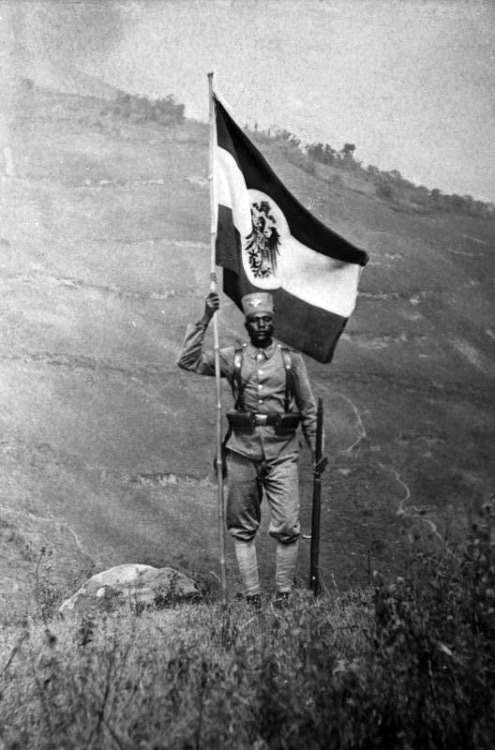
Askari wa Kizulu na bendera ya Mjerumani.
Wissmann established his headquarters at Bagamoyo only six miles from Abushiri's camp at Sanganzeru. He repudiated the armistice the Germans had made with Abushiri and routed his forces in May. Wissmann built a fort at Mpwapwa. Abushiri retreated inland and recruited 5,000 Maviti from the Yao and other tribes. They marched on Bagamoyo in October, but Abushiri was defeated again and fled. He was caught and hanged at Pangani on December 15. Wissmann then regained Kilwa, Lindi, and Mikindani.