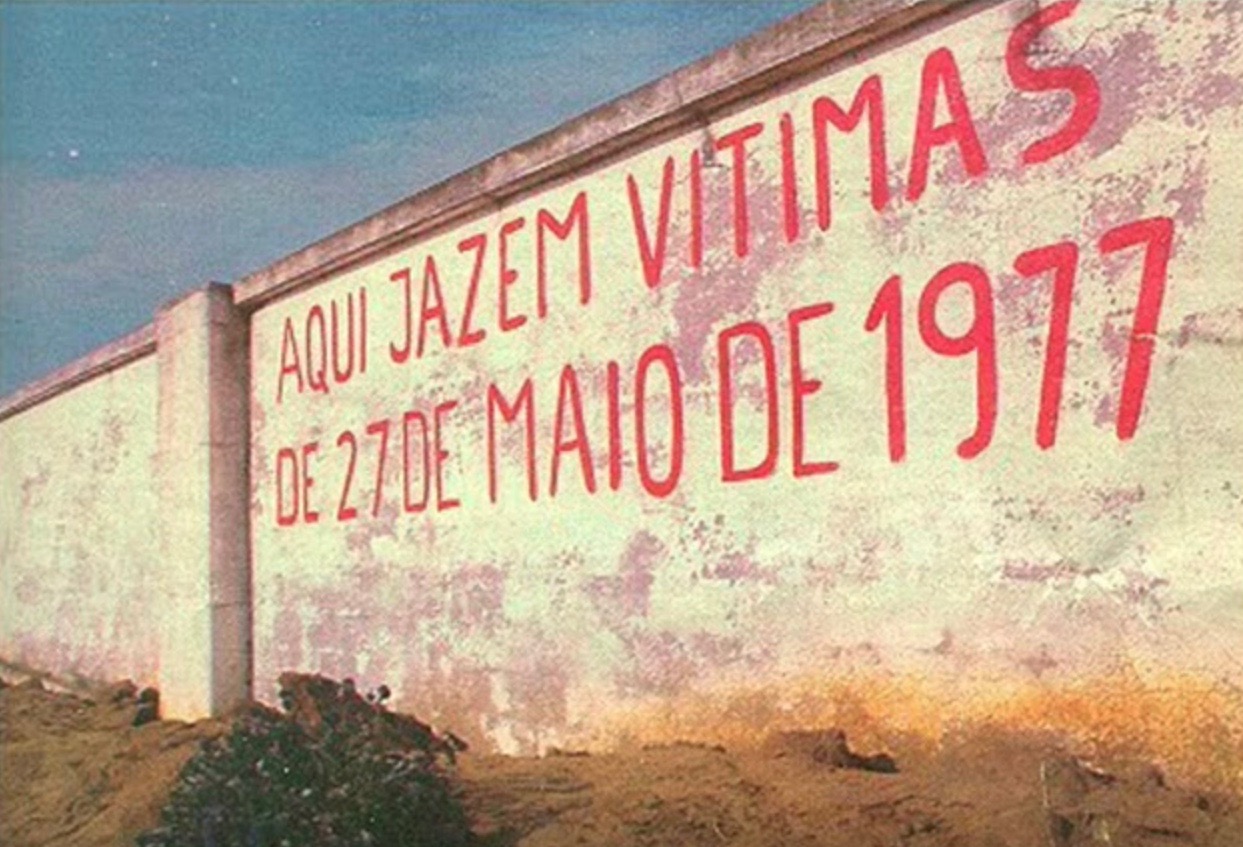
Joe Slovo, the SACP and the Angola massacre of May 1977
Paul Trewhela examines the Party’s response to the mass killings
Source:
Politicsweb.co.za,
26 January 2015
South Africa and the Angola massacre of May 1977
Despite (or because of) the legions of the Politically Correct in academe in South Africa and elsewhere since 1994, there has been no translation into English of a raft of books published in Portuguese since 2007, with a massive bearing on South Africa’s past and present.
The subject of these books is the massacre of thousands of mainly black Angolans between 1977 and 1979 by the MPLA government (in power for 40 years, this November) on a scale infinitely bigger and more horrific than anything carried out by the white governments of apartheid South Africa and Ian Smith’s Rhodesia, and infinitely more horrifically kept quiet. (And this is not even to begin talking about a further massacre carried out against its citizens in Angola by the same MPLA government in October/November 1992, in lieu of holding an election).
The hypocrisy stinks.
The issue is not less acute in view of the response of the South African Communist Party to the Marxist-Leninist massacre carried out by the MPLA, beginning in Luanda on 27 May 1977, even while it was continuing. Anyone can read online today the SACP’s endorsement of the massacre in its exile journal, The African Communist (No.71, Fourth quarter, 1977, p.51). Published in heavy black type while the regime’s killings were still going on, the SACP’s effective endorsement stated:
Long live the Unity of the Nation!
Death to the splitters!
Forward to the Congress!
The Struggle Continues!
“Death to the Splitters!”
The word “death” meant what it said, plus plus plus. Angola has never recovered.
Published by the SACP under the heading “How the Angolan coup was crushed” and anticipating the MPLA’s transformation of itself at its First Congress the following December into a Marxist-Leninist “Workers Party”, these words are prefaced by the SACP’s own introduction. This reads:
“On July 12, 1977, the Political Bureau of the Central Committee of MPLA issued in Luanda a 29-page statement analysing the origins and development of the attempted coup d’état on May 27 and showing how popular forces rallied to defeat the splitters. The statement, and the harsh experiences on which it is based, contain profound lessons for all revolutionaries, not only in Africa but throughout the world. The following extracts are from the statement….”
The MPLA’s injunction to kill, ordered by the ruling group in the party headed by President Agostinho Neto, was published in an issue of the African Communist commemorating the 60th anniversary of the revolution in Russia in 1917.
“Long live the October Revolution!” begins the editorial. “We dedicate this issue of our journal to the most important event of this century – the Great October Revolution in Russia in 1917, which marked a decisive turning point in the history of the world.” (p.5)
Communist revolution – “Death to the splitters!” – massacre. No Truth and Reconciliation here.
Like every issue of The African Communist between 1959 and 1994, the entire magazine is available online at the site of Digital Innovation South Africa (DISA), based at the University of KwaZulu-Natal, and readers can research its contents for themselves. (Ironically, the massacre which continued in Angola between 27 May 1977 and the death of President Neto in Moscow in September 1979, from cancer, was carried out mainly by a different, and very greatly feared, DISA – the MPLA’s secret police, Direcção de Informação e Segurança de Angola, the regime’s NKVD or Gestapo).
The entire text of the MPLA Politburo’s statement of 12 July 1977 should be read online through the link above, together with Lara Pawson’s painfully detailed investigation of what really happened, in her book, In the Name of the People: Angola’s Forgotten Massacre, published by IB Tauris in London in April last year – so far, the only effort made in any book written in English to get to the truth of this appalling episode in African history, with its long-standing, continuing effect in south-central Africa. That itself is a disgrace, in English-language studies of modern Africa.
A much briefer, but succinct and earlier account by Lara Pawson, “The 27 May in Angola: a view from below”, published by Instituto Português de Relações Internacionais (IPRI) at the New University, Lisbon, in June 2007, is available online in English, and should be read.
“The Angola massacres of 1977-79: Their national and regional consequences”, Professor Kenneth Good’s brief summary on Politicsweb last year of the historical thread in Lara Pawson’s book (29 September 2014), is a helpful survey.
In its statement of 12 July 1977, the MPLA Politburo decreed that those against whom it directed its vengeance would be “punished with all severity and without pardon.” (p.44)
It added: “We shall apply Revolutionary Democratic Dictatorship, to finish with saboteurs, parasites and speculators once and for all.” (African Communist, p.50)
There, in Angola, was the truth of Marx’s programme of the dictatorship, carried out under a blanket of terrified silence: “to finish…once and for all.”
Within three weeks of the beginning of the massacre, the members of the Co-ordinating Commission for the Liberation of Africa of the Organisation of African Union (OAU) met in Luanda on 14 June 1977, the killings going on under their noses. The Commission was addressed by President Neto, his address carried in the African Communist in the same issue as the MPLA Politburo’s exhortation to massacre, printed directly after its statement of 12 July 1977.
“Firmness pays”, he said. (p.57)
In an authentic moment of totalitarian practice, Neto had broadcast on national radio in Luanda on 28 May 1977, when the massacre was already well under way: “Certamente não vamos perder tempo com julgamentos. Seremos o mais breve possível. (“Certainly we will not waste time with trials. We will be as quick as possible.”)
As Neto told a meeting of Angolans when he made a visit to Cuba in July 1977, “There won’t be judicial processes. There will just be death sentences.” (quoted in Pawson, In the Name of the People, p.74)
While the MPLA’s killings were still going on, the African Communist continued in 1978 with a two-part interview by Joe Slovo with Lucio Lara, the most powerful man in Angola after Neto, member of the Politburo of the MPLA-Workers Party and secretary for organisation of the Central Committee. In the first part of the interview, headed “How the Angolan revolution was built”, Slovo addresses Lara as the leader of a party with “such a wealth and variety of revolutionary experiences.” (African Communist No.74, Third quarter, 1978, p.18)
In the second part (African Communist No.75, Fourth quarter, 1978), headed “Main phases in the development of the Angolan revolution”, he praises the MPLA for its “principled class position.” (p.56)
Some wealth, some variety, some principles….
Slovo asks no questions when Lucio Lara sails over the massacre of hundreds of black working class people in the township of Sambizanga – the Soweto of Luanda, where Cuban tanks roared over tin shanty houses, crushing women and children – with Lucio Lara sneering at the inhabitants as a “lumpenproletariat”, against whom the MPLA had to “take rigorous measures.” (Slovo interview, first part, pp.30-31)
In the same way, Slovo asks no question when Lara speaks of “the future extinction of the importance of the petty bourgeoisie in the revolutionary process” – a reference to the intellectuals whom it was executing en masse. (First part, p.34)
In the second part of the interview, Lara refers directly to what he calls “the factionalist outburst, in 1977” and to the oppositional current “of Nito Alves, of nitism, which organised the attempted coup in May 1977.” Slovo asks him directly: “What were the basic causes of the May 27 Coup, and how would you characterise the groupings which participated in it?” (pp.58-60)
To this, Lucio Lara responds by stating: “We can say that those who took part in the attempt were essentially a small group of petty bourgeois people, who also succeeded in involving some former fighters, particularly from areas close to Luanda with whom they were identified.” (p.60) Lara concludes that the MPLA was aiming towards “a state form whose essence is a revolutionary democratic dictatorship….” (p.66)
Again, this is never questioned by Slovo. He makes no attempt to find out what happened to individuals named by the MPLA Politburo in its statement of 12 July 1977, or to unknown thousands of others.
With Lucio Lara, we have here a political philosophy from the time of Joseph Stalin. A former functionary of the regime told Lara Pawson he was present at a highly-level meeting during the massacre, at which Lucio Lara “compared Angola with the Soviet Union ‘at the time of Stalin’.” (In the Name of the People, p.105)
There is no difference here between the mentality of Lucio Lara and Neto, on the one hand, and Stalin’s political philosophy of the mass purge of people perceived as having different opinions from his own, or Stalin’s “liquidation of the kulaks as a class”, or his deliberate engineering of the collectivisation famine in the Ukraine
This is also the closest I’m aware of in which a leader of the Central Committee of the SACP comes to a public identification of the SACP with Stalin’s philosophy of mass executions, in an African country in which the SACP and the ANC were based at a time when mass executions were being carried out.
South Africa needs much more intensive knowledge about what actually happened in Angola. The following books are among those available in Portuguese, but not in English translation. It is urgent that they be translated into English and made accessible to South Africans, among them, not least – the former members of Umkhonto we Sizwe who were based in Angola. These books include:
- Miguel “Michel” Francisco, Nuvem Negra: O drama do 27 de Maio de 1977 (Lisboa, Clássica Editora, 2007). “Nuvem negra” means “black cloud.” The author was a former commander in FAPLA’s 9th regiment, almost all of whose members were executed. He was saved by being ill at home on 27 May 1977, and escaped when DISA came for him, later imprisoned in a concentration camp. I understand this was the first autobiography on this subject. The author is alive, and was interviewed by Lara Pawson for her book.
- Álvaro Mateus and Dalila Cabrita Mateus , Purga em Angola: Nito Alves, Sita Valles, Zé Van Dunem o 27 de maio de 1977 (Porto: ASA Editores, 2007). The title means “purge in Angola”, followed by the names of three MPLA leaders who were executed. In an interview in a Portuguese magazine in 2008, the widow of Agostinho Neto described the author of the book, Dalila Mateus, an historian, as having been “dishonest and lying” (“desonesta e mentirosa”) about the massacre. She was convicted of aggravated defamation in a libel case in Portugal in April 2013, and fined. The verdict was overturned by the court of appeal (Tribunal da Relação) in Lisbon on 20 November 2013. Dalila Mateus died in October last year.
- Américo Cardoso Botelho, Holocausto em Angola, Memórias de entre o Cárcere e o Cemitério (Lisboa: Nova Vega, 2008). The title means “Holocaust in Angola: Memories of the prison and the cemetry.” Botelho, a Portuguese engineer and senior figure in the diamond mining company, Diamang, was imprisoned for three years, and smuggled his cryptic diary notes out of prison.
- José Fragoso, O Meu Testemunho – A Purga do 27 de Maio de 1977 e as suas Consequências Trágicas (Edição Sistema J, Luanda, 2009). Fragoso is a former FAPLA commander in the 9th regiment, later a general, who was imprisoned by DISA. The title means “My testimony: The purge of 27 May 1977 and its tragic consequences.”
These and other sources published in Portuguese remain inaccessible to most South Africans.
It is no accident that the ANC’s most notorious prison camp for its own members in exile was in Angola, known to its victims by a Portuguese name – Quatro. It was founded on the MPLA model.
From first-hand observations, Botelho’s book records the following:
“Factos pouco conhecidos como a detenção, às ordens do MPLA, dos militantes sul-africanos do ANC que por essa época se treinavam em técnicas de guerrilha em Angola e que pagaram em intermináveis sessões de tortura a sua recusa em participar na guerra civil angolana….”
In a rough translation into English: “Little known facts, such as the detention on MPLA orders of South African activists of the ANC who were being trained in guerrilla techniques in Angola at that time, and who paid in endless sessions of torture for their refusal to participate in the Angolan civil war….”
The Angola massacre is a South African issue.
In Russia, the archives of the KGB, the International Department of the CPSU and the Defence Ministry remain closed and were never declassified – and so provide no light on the massacre in Angola. That is no reason for English-language scholars of the sub-continent to deprive readers with the same constriction.
A disparaging review of Lara Pawson’s pioneering account in English of the massacre by Colin Darch, Senior Information Specialist in the University Library, University of Cape Town, which was published at the end of last year in the South African Historical Journal (Vol. 66, No.4), makes no reference to any of the sources above which have been published since 2007, written in Portuguese. Five of his six references are dated in the late 1970s from the immediate aftermath of the massacre, and his most recent reference is dated 1992. This disregards Lara Pawson’s reliance on recent sources and her enormous care not to prejudge on what she was told and – reluctantly – found out.
By contrast, an important paper by a teaching associate at Cambridge University and former BBC correspondent in Angola, Justin Pearce, published this month in the Journal of Southern African Studies (Vol.41, No.1), with the title “Contesting the past in Angolan politics”, provides scholars with independent confirmation of the justice of Lara Pawson’s researches.
Justin Pearce reports a “renewed preoccupation with history in Angolan political discourses over the past decade”, and how “young active activists are preoccupied with events that they are not old enough to remember.” (p.104) A major theme in his paper is the control of memory in southern Africa by the ruling political elites, and he gives respectful attention to Lara Pawson’s book, noting that she “describes how even Angolans who had lost relatives in the violence of 1977 appeared to collude in the silence.” (p.112)
Pearce notes that the strategy of the MPLA and the Angolan government has been “as much about silencing inconvenient versions of history as about its preferred ones”, but that despite this there has been an “emergence of regular street protests in Luanda from early 2000”, loosely organised and now referred to as JuventudeRevoluciona´ria (Revolutionary Youth). (pp.112-13)
“They described the attitude of their parents’ and older generations as one of fear: a fear of taking political action as a result of the experiences they had lived through. ‘Those who lived through the trauma of 27 May are the ones who are frightened’, one activist said. Another added, ‘My own mother says “watch out or the MPLA will kill you” – I can’t live in this dictatorship’, and then proceeded to recite the names of Nito Alves and others killed in 1977, names that his mother would not have dared to speak publicly.” (p.114)
This confirms that, alongside a real “wealth” and “variety” of historical books now available in Angola, a revolution in consciousness is under way among young people, best compared with the spirit of fearless inquiry, defiance and political contestation of the early period of the Black Consciousness Movement in South Africa in the late 1960s and 1970s, under the leadership of Steve Biko.
It will not be silenced, and its effects will reverberate through the sub-continent.
People in South Africa, Namibia, Zimbabwe and Mozambique should keep informed. In Angola, conscientisation is on the move.
****


eastafricatanzanialawinfo.blogspot.com

sheriahub.com